
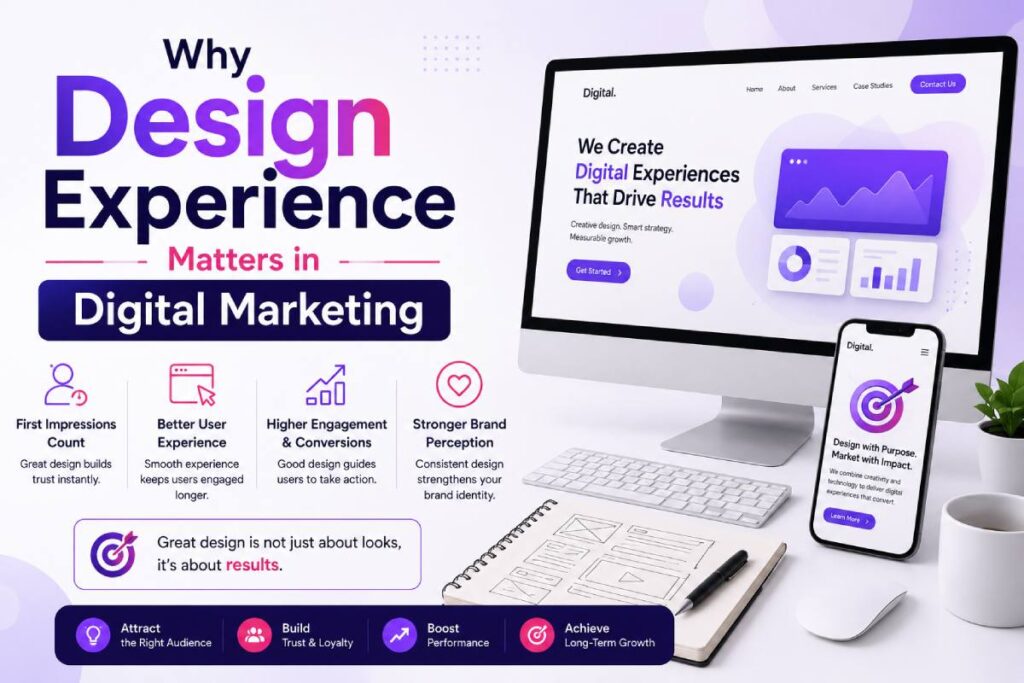
There’s a moment every business owner has experienced — clicking onto a competitor’s website and feeling, almost instantly, that something is off. The layout feels cluttered. The fonts are hard to read. The page takes too long to load. Before a single word of their content has registered, something about the experience has already communicated, “I’m not sure I trust this.”
Now flip that. Think about a brand whose website makes you stop scrolling. Clean layout. Clear message. The kind of design that says, without needing to say it directly, that the people behind this know what they’re doing. You haven’t read a review yet. You haven’t seen pricing. But you’re already leaning in.
That’s design experience doing its job — and it’s one of the most underestimated forces in digital marketing.
Most marketing conversations center on targeting and traffic: how do you get more people to see your content, click your ads, and visit your website? Those are legitimate questions. But what happens the moment someone arrives is just as important as the mechanics of getting them there. A poorly designed experience quietly undoes the work of every campaign running upstream of it.
This guide looks at why design experience is a genuine marketing variable — not just an aesthetic preference — and what it takes to make it work in your favor across every digital channel you invest in.
Design Is Communication, Not Decoration
One of the most persistent misconceptions about design is that it’s primarily about how things look. In a marketing context, design is actually about how things communicate — and how fast they do it.
A website visitor decides within the first few seconds whether they’re in the right place. In that window, they haven’t read your copy. They haven’t watched your video. They’ve absorbed the visual language of the page — the layout, the color palette, the typography, the imagery — and formed a judgement about whether this brand is credible, relevant, and worth more of their attention.
That judgement happens almost entirely below conscious thought. People don’t think “this color scheme lacks authority” — they just feel uncertain. They don’t think “the hierarchy of this page is unclear” — they just feel confused. The experience creates the feeling, and the feeling drives the behavior.
This is why design decisions are marketing decisions. Choosing a cluttered homepage layout isn’t a stylistic choice — it’s a choice that increases bounce rate. Choosing low-contrast text isn’t a minor visual preference — it’s a choice that reduces how much content gets read. Every design element either supports or undermines the marketing goal it’s in service of.
Where Design Experience Directly Affects Marketing Outcomes
The influence of design on marketing performance shows up across every channel and touchpoint. Understanding the specific mechanisms makes it easier to prioritize where to invest.
First Impressions and Credibility
Research from multiple studies has found that the majority of a website’s credibility assessment is design-driven. Users evaluate trustworthiness based on visual presentation before they evaluate content quality. A business with exceptional service but an outdated, inconsistent design presentation is fighting an uphill credibility battle from the first second of every visit.
In highly competitive markets — where potential customers have multiple credible options and switching costs are low — first-impression design quality can be the difference between someone continuing to explore or clicking back to Google to find the next option.
Conversion Rate and Sales Performance
Every step between a visitor’s intent and completing a conversion is an opportunity for design to either smooth the path or create friction. A well-designed call-to-action button with clear, specific copy converts better than a generic one buried in a cluttered layout. A form that’s visually clean and asks only for necessary information gets completed more often than one that looks overwhelming. A product page with high-quality imagery, readable typography, and clearly displayed trust signals converts at a higher rate than one where these elements are missing or poorly executed.
Conversion rate improvement is, to a large extent, a design discipline — and a 1% improvement in conversion rate has the same business impact as a 1% increase in traffic, without any additional advertising spend.
SEO and Organic Visibility
Google’s approach to ranking has steadily incorporated signals that reflect the quality of the design experience. Page speed, mobile responsiveness, Core Web Vitals scores, and behavioral signals like bounce rate and time-on-site all feed into how Google evaluates a page’s overall quality. A visually well-designed, fast-loading, mobile-friendly site earns better behavioral signals from visitors, which reinforces organic rankings over time.
Poor design experience creates a compounding SEO disadvantage: visitors leave quickly, engagement drops, behavioral signals decline, and rankings suffer, which reduces organic visibility, which reduces the traffic the design problem would have affected anyway. Fixing the design breaks that cycle in the opposite direction.
Brand Consistency and Recognition
Consistent visual design across every digital touchpoint — website, social media profiles, email templates, paid ad creative — builds the kind of brand recognition that compounds over time. When someone sees your ad, then visits your website, then receives your email, and the visual language is cohesive and recognizable throughout, that consistency builds trust and familiarity faster than any of those touchpoints could achieve in isolation.
Inconsistency, by contrast, creates cognitive friction. When the brand doesn’t look the same across channels, it signals a lack of professionalism and undermines the trust-building that consistent touchpoints would otherwise accumulate.
Social Media Performance and Engagement
Visual design is perhaps the most dominant performance variable on social media platforms, where the feed is competitive and attention is short. The difference between a post that gets scrolled past and one that stops the thumb is almost entirely a design decision — composition, color, contrast, and visual hierarchy all determine whether content gets seen or ignored. Even the most compelling written content underperforms when the visual presentation doesn’t demand attention in a crowded feed.
The Most Common Design Mistakes That Hurt Marketing Performance
Identifying the design problems that most reliably suppress marketing outcomes is a faster path to improvement than overhauling everything at once.
Visual Clutter and Competing Priorities
A page that’s trying to say too many things simultaneously ends up communicating nothing clearly. When every element is competing for attention – multiple prominent calls-to-action, busy backgrounds, dense text blocks, conflicting visual weights — visitors don’t know where to look or what to do. Effective marketing design creates a clear visual hierarchy that guides the eye naturally toward the most important action.
Inconsistent Typography and Color
Typography and color are the most immediately noticeable design variables on any page. Inconsistent font usage — too many typefaces, irregular sizing, insufficient contrast between text and background — creates an impression of disorder that undermines credibility before any content is read. A coherent, well-applied visual system communicates professionalism in a way that’s hard to articulate but immediately felt.
Ignoring Mobile Design
A design that looks considered on a desktop and chaotic on a phone sends inconsistent signals about the brand’s attention to detail — and leaves a significant share of potential customers with a poor first impression. Given that mobile traffic represents the majority of visits for most businesses, mobile design quality is a primary concern, not an afterthought.
Generic Stock Imagery
Overuse of generic stock photography — the kind of imagery that looks interchangeable with any other business in any other industry — actively undermines the trust and differentiation that good design should build. Authentic imagery, original illustrations, or even thoughtfully selected and well-curated photography communicate specificity and care in ways that generic stock cannot replicate.
Slow-Loading Pages
Design choices have direct speed implications. Unoptimized images, heavy animations, multiple third-party scripts loaded on page render — all of these are design and development decisions that affect load time. A design that’s visually impressive but functionally slow trades short-term aesthetic impact for long-term conversion and ranking performance.
What Good Design Experience Actually Looks Like
Good design experience in digital marketing isn’t about following a single aesthetic trend or replicating what larger brands do. It’s about creating clarity, coherence, and confidence at every touchpoint a potential customer encounters.
Clarity of Purpose on Every Page
Every page on a website should have one primary goal, and the design should make that goal obvious. The homepage communicates what the business does and who it’s for. A service page answers the key questions a prospect has before deciding to reach out. A landing page guides a visitor toward a single, specific action. When design serves a clear purpose, it performs; when it tries to serve everything, it serves nothing.
Visual Hierarchy That Guides Without Forcing
Strong design experience creates a natural reading and navigation path that visitors follow without feeling directed. Headlines capture attention and communicate the main message. Subheadings organize sections and reward scanning. Body copy provides depth for those who want it. Calls-to-action appear at the moments when a visitor is ready to act. None of this happens by accident — it’s the result of deliberate hierarchy decisions that shape how the page is experienced.
Speed and Performance as Design Priorities
Every design decision should be evaluated partly through the lens of its performance impact. Images should be web-optimized without sacrificing quality. Animations should add meaning, not just motion. Third-party elements should be loaded selectively. A design that’s built with performance as a consideration from the start behaves fundamentally differently from one where performance is an afterthought.
Coherent Visual Identity Across All Channels
From the website to the social media feed to the email header to the ad creative, a cohesive visual identity reinforces brand recognition and professionalism at every touchpoint. This doesn’t require expensive rebranding — it requires consistency in color application, typography, imagery style, and tone wherever the brand appears.
Design Experience Across Specific Digital Marketing Channels
Website: The Central Hub of Design Experience
The website is where design experience has its greatest cumulative impact. It’s the destination for virtually every other marketing channel—paid ads, organic search, social media, and email—and the quality of its design either amplifies or limits the return on each of those investments. A fast, clear, professionally designed website makes every other marketing channel more effective. A slow, cluttered, dated one imposes a ceiling on what any other channel can achieve.
Email Marketing: Design in the Inbox
Email design affects both open rates and click-through rates. A clean, well-structured email template with a clear visual hierarchy — readable on a phone, fast-loading, and with a single focused call-to-action — consistently outperforms a dense, image-heavy email that requires scrolling to find the point. Accessibility matters here too: emails designed to be readable by screen readers and in plain-text environments reach more of the intended audience.
Paid Advertising: Design as Performance Variable
Ad creative quality is one of the most significant variables in paid social performance. On platforms like Facebook and Instagram, where ad and organic content compete for the same feed space, design quality determines whether an ad gets noticed or ignored. The same budget allocated to high-quality, well-designed creative consistently outperforms the same budget allocated to generic or poorly executed creative — often by a wide margin.
Content Marketing: Presentation Is Part of the Message
Well-researched, genuinely useful content published in a way that’s difficult to read, visually unappealing, or poorly formatted on mobile will underperform relative to its quality. Typographic readability, white space, well-formatted subheadings, and properly sized imagery all affect how much of a piece of content a reader actually consumes, which affects time on page, social shares, and the SEO signals those behaviors generate.
How a Website Designing Agency Changes the Marketing Equation
Designing for marketing performance requires a different kind of thinking than designing purely for aesthetics. A site that looks beautiful in a portfolio review but loads slowly, confuses first-time visitors, or makes conversion paths difficult has failed at its primary job — regardless of how it looks.
This is the distinction that separates a capable website designing agency from a general design studio. An agency that works within a digital marketing context understands that every design decision has downstream marketing consequences — that the structure of a homepage affects bounce rate, that the placement of a call-to-action affects conversion rate, that image optimization affects page speed and therefore rankings, that mobile design quality affects performance across a growing majority of visits.
TrendWaltz approaches design within this marketing-first framework. As a website designing company that operates as part of a full-service digital marketing team, design decisions are made in the context of SEO implications, conversion goals, paid campaign landing page performance, and overall brand consistency across channels. The website is treated as a marketing tool, not just a digital brochure — and it’s built and evaluated accordingly.
The result is design work that doesn’t just look right but performs right. Sites that load fast, communicate clearly, guide visitors through a logical journey toward conversion, and support the organic and paid campaigns running alongside them rather than quietly limiting what those campaigns can achieve.
Final Thoughts
Design experience isn’t a layer of polish applied after the real marketing work is done. It’s woven into the performance of every channel, every campaign, and every touchpoint a potential customer encounters. The brands that recognize this — and invest in design as a core marketing function rather than an optional visual upgrade — consistently outperform those that treat it as a nice-to-have.
Every dollar spent driving traffic is worth more when the destination is well-designed. Every piece of content performs better when it’s presented well. Every ad dollar works harder when the landing page it leads to is fast, clear, and built to convert. Design experience amplifies everything around it — or quietly holds it back, depending on which side of that investment you’re on.
In a market where competition for attention is fierce and first impressions are formed in seconds, design experience isn’t optional. It’s the difference between marketing that builds on itself and marketing that keeps starting over.
Frequently Asked Questions
1. What is design experience in digital marketing?
‘Design experience’ refers to how a user feels when interacting with your brand across digital touchpoints — website, ads, emails, and social content. It combines visual quality, usability, and clarity to shape whether visitors trust, engage with, and convert through your marketing channels.
2. How does website design affect SEO rankings?
Google factors page speed, mobile responsiveness, and Core Web Vitals into rankings. Poor design leads to high bounce rates and low engagement, which sends negative signals to search algorithms. A well-designed, fast-loading site reinforces SEO performance from both technical and behavioral perspectives.
3. Why should businesses work with a website design agency instead of using templates?
A professional website designing agency builds sites with marketing performance in mind — optimizing for conversions, speed, and SEO rather than just appearances. Templates offer convenience but often lack the strategic structure, performance optimization, and brand specificity that purpose-built design delivers for growing businesses.
4. How does TrendWaltz integrate design into its digital marketing strategy?
TrendWaltz functions as a website designing company within a full-service marketing team, ensuring design decisions serve SEO, conversion, and campaign goals simultaneously. Sites are built for performance — fast loading, mobile-first, conversion-focused — not just visual presentation, making every marketing channel more effective.
5. How often should a business update its website design?
A meaningful design review every two to three years is reasonable for most businesses, with incremental UX improvements ongoing. If bounce rates rise, conversions stall, or Core Web Vitals scores decline noticeably, that’s a clear signal that design updates are overdue, regardless of the timeline.