Most product launches fail quietly. Not with a dramatic crash, but with a slow, underwhelming trickle of sales that never builds into the momentum everyone expected. The product is solid. The team worked hard. But the launch lands without impact — and within a few months, it’s absorbing marketing spend without returning much of anything.
When this happens, the instinct is to look for a product problem. Was the pricing wrong? Was the feature set incomplete? Did the market not want it? Sometimes those are valid questions. But far more often, the real problem is strategic: the product was launched without a well-constructed marketing strategy behind it, or the strategy was built too late, or the channels and messages were chosen based on habit rather than a clear understanding of how this specific product reaches this specific buyer.
A strong product launch marketing strategy isn’t just a list of channels and a calendar. It’s a structured answer to a series of hard questions — who exactly is this for, what do they need to believe before they’ll buy, how do we create awareness and desire efficiently, and what does success look like at each stage of the launch window? Getting those answers right before spending the budget changes everything about how a launch performs.
This guide walks through how to build that strategy – from the pre-launch foundation work through to the post-launch activities that turn early sales into sustained growth.
Why Most Product Launch Strategies Underperform
Before building a launch strategy, it helps to understand the most common failure modes — because they’re predictable enough to be worth naming and deliberately avoiding.
Launching Without a Defined Audience
“Everyone could use this” is a marketing strategy that reaches nobody. The most successful product launches are built around a specific, clearly defined primary audience — a segment whose problem the product solves best, whose purchase behavior is understood, and whose attention can be reached through identifiable channels. Trying to market broadly at launch dilutes the budget, produces generic messaging, and makes it nearly impossible to optimize because the signal-to-noise ratio in the data is too high.
Treating Launch Day as the Strategy
A product launch isn’t a single moment—it’s a window with distinct phases that require different activities and different metrics. Teams that invest all their energy in the launch day announcement and have no pre-launch buildup, no mid-launch optimization plan, and no post-launch follow-through leave most of the available opportunity untouched.
Building Awareness Without a Conversion Path
Generating awareness for a new product is only valuable if there’s a clear, frictionless path from that awareness to a purchase. A product launch campaign that drives impressions and clicks to a landing page that’s poorly designed, unconvincing, or hard to navigate on mobile is effectively paying to introduce people to something they’ll never buy. Awareness and conversion infrastructure need to be built simultaneously.
Underinvesting in Paid Distribution at Launch
Organic reach — through SEO, social media, and word of mouth — is valuable but slow. At launch, when a new product has no organic history, no reviews, no backlinks, and no social proof, organic channels can’t carry the weight of building awareness quickly. Paid advertising is often the only mechanism capable of generating meaningful visibility in the compressed timeframe that a product launch requires. Underinvesting in paid distribution at launch is a primary reason many products never reach the audience size needed to build momentum.
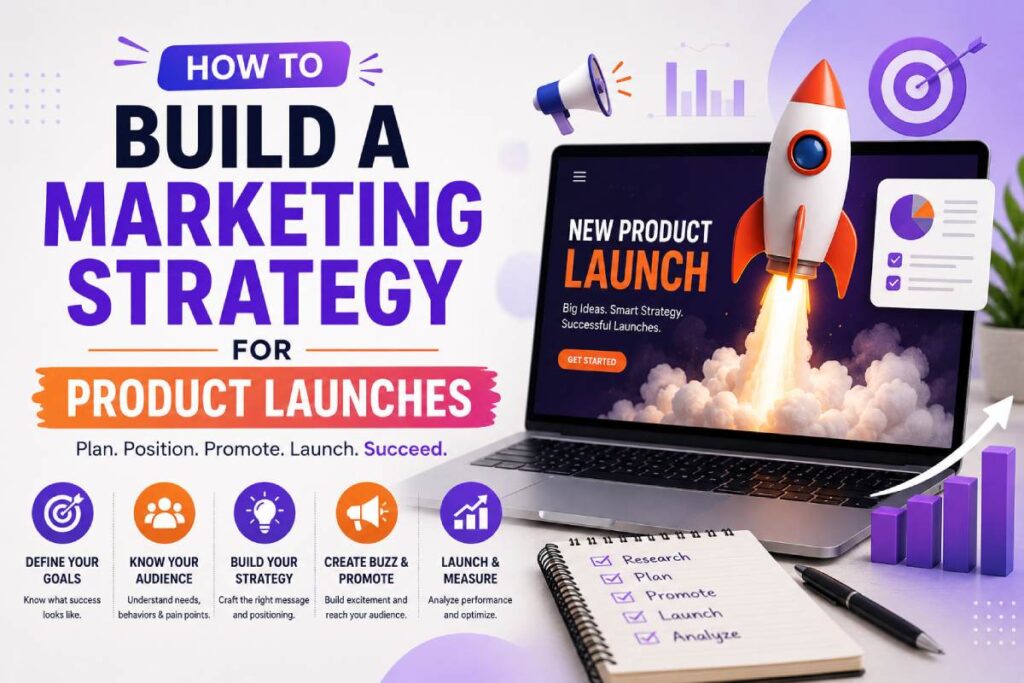
Phase One: Pre-Launch Foundation (8–12 Weeks Before Launch)
The most consequential work in a product launch happens before the launch itself. The pre-launch phase is where the strategic foundation gets built — audience definition, positioning, messaging, channel selection, and infrastructure – that every subsequent activity depends on.
Step 1: Define Your Target Audience With Precision
Start with the most specific version of your ideal buyer, not the broadest possible market. Identify:
- Demographics: age range, location, income level, occupation — the contextual factors that shape purchasing behavior
- Psychographics: values, aspirations, frustrations, and the identity signals that make them responsive to certain types of messaging
- The specific problem your product solves for this person — described in the language they actually use, not the language your product team uses internally
- Where they currently look for solutions: which search queries, which social platforms, which publications, which communities
- What objections they’re likely to have — price sensitivity, skepticism about a new product, comparison with existing alternatives
This audience definition becomes the brief for every piece of creative, every campaign targeting decision, and every channel selection made throughout the launch. The more specific it is, the more useful it is.
Step 2: Develop Your Positioning and Core Messaging
Positioning answers the fundamental question: why should this specific audience choose this product over every alternative available to them, including doing nothing at all?
A clear positioning statement typically addresses:
- The specific problem being solved — stated in terms of the customer’s experience, not the product’s features
- The primary differentiator — what makes this meaningfully better or different from existing alternatives
- The proof points — what evidence supports the differentiating claim (performance data, ingredients, methodology, certifications, founder credentials)
- The emotional outcome — how the customer’s life is different after using this product
From this positioning, develop the core messaging hierarchy: a primary headline message, two to three supporting messages that substantiate it, and the specific language and framing that resonates with the target audience. This messaging framework becomes the source material for every ad, every email, every landing page, and every social post created for the launch.
Step 3: Build the Launch Infrastructure
Before spending a dollar on driving traffic, ensure the infrastructure that converts that traffic is in place and tested:
- A dedicated product landing page or product detail page built to convert — clear headline, compelling product imagery, benefit-focused copy, prominent social proof placement, and a frictionless purchase path
- Conversion tracking properly configured — Google Analytics 4, Meta Pixel, and any other platform pixels installed and verified so that every campaign can be attributed and optimized correctly
- Email capture mechanism for pre-launch — a waitlist, early access offer, or preview sign-up that builds a warm audience before the launch date and generates owned-channel contacts independently of ad spend
- Retargeting audiences in place — with pixels installed, people who visit the pre-launch page, abandon cart, or view the product page are automatically added to retargeting pools that paid campaigns can reach from day one of launch
Step 4: Build and Warm Your Paid Audiences Early
Paid advertising platforms optimize delivery based on audience data. An ad campaign launched cold — with no prior audience behavior to learn from — takes days or weeks to reach its performance potential as the algorithm gathers signal. Campaigns launched into warm, well-seeded audiences perform from the start.
In the pre-launch phase, run low-cost awareness and traffic campaigns to:
- Grow your website visitor pool so retargeting campaigns have an audience to work with at launch
- Test creative concepts and messaging angles at modest spend to identify which versions resonate before committing launch budgets to untested approaches
- Build custom audiences from your email list and social followers that can serve as seed data for lookalike expansion at launch
- Gather baseline performance data — click-through rates, cost-per-click, landing page behavior — that informs budget allocation and bidding strategy during the launch window
Phase Two: Pre-Launch Activation (2–4 Weeks Before Launch)
With the foundation built, the pre-launch activation phase shifts from preparation to momentum-building. The goal here is to create genuine anticipation and grow the warm audience that launch-day campaigns will activate.
Step 5: Launch Your Pre-Launch Content and SEO Strategy
SEO is a long-term channel, but the pre-launch window is when foundation content should go live—giving search engines time to index it before launch day and giving potential customers something to find when they search for your product category:
- Publish educational content that addresses the problem your product solves – not product announcements, but genuinely useful content that attracts people already searching for solutions in your category
- Optimize your product page for relevant search terms before launch, including the product name, category keywords, and the specific problem-solution language your audience uses
- Build relevant internal links from existing site content to the new product page to pass authority and signal importance to search engines
Step 6: Build Social Media Momentum Before Launch
Social media during the pre-launch window serves a different purpose than during the launch itself — it’s about building anticipation, not driving immediate conversions.
- Teaser content that hints at the product without fully revealing it — building curiosity in your existing audience before launch day
- Behind-the-scenes content showing the product’s development, the problem it solves, or the people behind it — humanizing the launch and building emotional investment
- Countdown content and early access announcements for followers — rewarding your most engaged audience with the feeling of insider access
- User-generated content from beta users or early testers, where possible — authentic early opinions carry more persuasive weight than brand-produced content
Step 7: Activate Your Email List
If you’ve been building an email waitlist during the pre-launch phase, now is when it starts generating returns. A well-sequenced pre-launch email series might include the following:
- An initial teaser email to your full list: “something is coming” messaging with enough detail to generate interest without revealing everything
- A product reveal email to your waitlist: full product details, positioning, launch date, and early access offer or pre-launch pricing
- A series of benefit-focused emails over the following weeks: each one addressing a specific customer benefit, objection, or use case in depth
- A final reminder email in the 48 hours before launch, creating urgency for early access or launch-day offers
Phase Three: Launch Execution
Launch day and the immediate launch window — typically the first two to four weeks of active sales — is when the paid advertising infrastructure, content strategy, and email sequences built in prior phases all activate simultaneously. The goal isn’t to improvise during this window; it’s to execute the plan that was built and refined over the preceding weeks while actively monitoring and optimizing based on real performance data.
Step 8: Launch Your Full Paid Advertising Strategy
The launch window is when paid advertising investment reaches its peak — and when the quality of campaign structure, creative, and audience architecture determines how efficiently that investment converts to sales.
A complete launch paid advertising strategy typically includes the following:
- Cold prospecting campaigns: reaching new audiences who match your buyer profile but haven’t encountered the product yet — using interest targeting, behavioral targeting, and lookalike audiences built from your email list and early visitors
- Warm retargeting campaigns: serving ads specifically to people who’ve already shown interest — website visitors, product page viewers, cart abandoners, email subscribers who haven’t yet purchased
- Social proof amplification: running ads featuring early reviews, customer testimonials, or launch results (“over 500 orders in the first week”) to address skepticism and build credibility quickly
- Search campaigns: capturing people actively searching for your product name or category keywords with high-intent search ads that meet them at their moment of maximum purchase readiness
Managing these campaigns through the launch window requires daily monitoring and active optimization — adjusting budgets behind top-performing ad sets, pausing underperformers, refreshing creative as fatigue sets in, and responding to inventory or delivery changes that should affect campaign messaging. This is the kind of hands-on, data-driven management that a skilled paid advertising agency provides — and where the difference between a managed campaign and an unmanaged one shows up most clearly in launch performance.
Step 9: Execute Your Launch Email Sequence
The launch email sequence should work in parallel with paid campaigns – reaching your existing audience through an owned channel that costs nothing incrementally while reinforcing the messages your paid campaigns are carrying to cold audiences:
- A launch announcement email on day one: the product is live; here’s everything you need to know, here’s why it matters to you specifically
- A social proof email within the first week: early customer reactions, first reviews, initial results if they’re compelling
- A benefit-focused mid-launch email: going deeper on the aspect of the product most important to your audience’s specific problem
- An urgency email if applicable: limited stock, launch pricing ending, bonus offer expiring — genuine urgency, not manufactured
Step 10: Activate PR and Partnership Channels
Paid and owned channels carry a launch effectively, but earned media — press coverage, influencer partnerships, podcast features, and industry publication mentions — adds a layer of third-party credibility that brand-produced content can’t replicate.
During the launch window, activate:
- Media outreach to journalists and publications covering your product category — with a clear story angle, not just a product announcement
- Influencer partnerships with creators whose audiences overlap your target buyer — prioritizing authentic fit over follower count, since micro-influencers with highly relevant audiences typically drive stronger conversion than large creators with broad, less targeted reach
- Partnership amplification: co-marketing with complementary brands, cross-promotion with businesses that serve the same audience, or affiliate arrangements that incentivize partners to promote the launch
Phase Four: Post-Launch — Converting Momentum Into Sustained Growth
The launch window creates a spike. What happens in the weeks after determines whether that spike becomes the beginning of a growth curve or a peak that immediately declines.
Step 11: Analyze Launch Performance and Iterate
Within the first two weeks after the launch peak, conduct a thorough performance review:
- Which paid channels and campaigns delivered the lowest cost per acquisition and highest ROAS?
- Which email subject lines and messaging angles generated the strongest open and conversion rates?
- Which audience segments converted at the highest rate — and what does that tell you about where to concentrate post-launch spend?
- What objections are appearing in customer service enquiries, reviews, or social comments — and how should those inform messaging adjustments?
This data doesn’t just help optimize ongoing campaigns — it informs future product launches, making each subsequent launch more efficient because you’re building from real performance evidence rather than assumptions.
Step 12: Build Post-Purchase Flows for Retention and Advocacy
Every customer acquired at launch is a relationship that can generate compounding value over time — through repeat purchases, referrals, and reviews. The post-launch period is when to build the automated sequences that activate that potential:
- A post-purchase email sequence: onboarding content that helps customers get maximum value from the product, building satisfaction that translates into positive reviews and repeat purchase behavior
- A review request email: sent at the right moment after delivery and first use, making it easy for satisfied customers to leave a review on the platform that matters most to your future buyers
- A referral incentive: encouraging customers who’ve had a positive experience to share the product with their network in exchange for a discount or reward
Step 13: Extend Paid Advertising Into Sustained Growth Campaigns
Post-launch, the paid advertising strategy transitions from high-volume launch campaigns to more efficient sustained-growth campaigns:
- Retargeting campaigns to non-converters who showed interest during the launch but didn’t purchase — sometimes a second or third exposure with different creative or a different offer is the nudge they needed
- Lookalike campaigns seeded from launch purchasers — your actual buyers from the launch window are the highest-quality seed audience for finding similar new customers
- Content amplification campaigns that put your best-performing launch content (reviews, testimonials, use-case content) in front of new audiences cost-effectively
Working with a capable paid advertising company in the post-launch phase ensures that the learnings from the launch window are carried forward into ongoing campaigns rather than being lost when the launch team moves on to the next project. The optimization work done during launch — identifying winning creative, discovering high-converting audience segments, and refining bid strategies — becomes the foundation for the most efficient ongoing customer acquisition possible.
The Role of Paid Advertising Services in a Product Launch
Across every phase of a product launch — from pre-launch audience building through post-launch sustained growth — paid advertising is one of the most consistently critical variables in whether a launch succeeds or struggles.
This is particularly true because product launches operate in compressed timeframes where organic channels can’t build fast enough to carry the load. A new product has no organic search history, no accumulated reviews, no backlink profile, and no established social audience. Paid advertising is the mechanism that bridges that gap — creating visibility, generating social proof through early sales volume, and reaching the specific audience who would benefit most from the product before organic channels have had time to develop.
The difference between well-managed and poorly managed paid advertising at launch is significant enough to determine whether a product finds its initial audience or stalls out before it ever gets real market feedback. Campaign structure, creative quality, audience architecture, bid strategy, and daily optimization aren’t details — they’re the primary levers that determine launch-window ROAS.
TrendWaltz works with brands across their full product launch cycle — building pre-launch audience infrastructure, structuring and managing paid advertising services through the launch window, and transitioning campaigns into sustained-growth mode in the weeks that follow. As a full-service paid advertising agency, the team brings both the strategic architecture and the hands-on optimization discipline that product launches specifically demand, giving new products the best possible foundation for building early momentum and converting it into lasting market presence.
Final Thoughts
A product launch is one of the highest-stakes marketing moments a business faces — and one of the most time-compressed. There’s a limited window in which early momentum can be built, first impressions are formed, and the trajectory of a new product is established. What happens in that window is almost entirely a function of how well the marketing strategy was built before it opened.
The businesses that consistently launch successfully share a recognizable set of characteristics: they define their audience specifically before building campaigns, they construct the conversion infrastructure before driving traffic, they use paid advertising to create visibility that organic channels can’t deliver quickly, they treat the launch as a multi-phase process rather than a single day, and they capture and act on performance data throughout rather than waiting until the launch is over to evaluate what happened.
None of this is especially complicated in principle. But executing it well across multiple channels under time pressure while also building a product and managing a business – that’s where the real challenge lives. Getting that execution right is the difference between a launch that builds momentum and one that quietly underperforms expectations despite a product that genuinely deserved better.
Frequently Asked Questions
1. How far in advance should a business start planning a product launch marketing strategy?
Eight to twelve weeks is the minimum for a well-prepared launch—enough time to build audiences, test creative, set up conversion infrastructure, and run pre-launch content before launch day. Brands launching into competitive categories or planning significant paid advertising investment benefit from starting even earlier, since audience-warming and creative-testing compound over time.
2. How does TrendWaltz support businesses with product launch marketing?
TrendWaltz manages the full launch cycle — from pre-launch audience building and paid advertising services setup through active campaign management during the launch window and post-launch growth optimization. As a full-service paid advertising agency, the team handles campaign architecture, creative testing, daily bid management, and performance analysis, giving new products the strongest possible paid foundation across every launch phase.
3. Why is paid advertising so important during a product launch, specifically?
New products have no organic history — no search rankings, no reviews, no social proof. Paid advertising is the only channel fast enough to generate meaningful visibility in a compressed launch window. A skilled paid advertising company builds and manages the campaigns that bridge that gap, creating early awareness and driving the first sales that organic channels need time to develop.
4. What’s the most important thing to get right before spending money on launch advertising?
The conversion infrastructure — specifically the landing page and conversion tracking setup. Spending on paid advertising before the destination page is optimized and tracking is verified means paying for data you can’t use and conversions you can’t attribute. Get the infrastructure right first; every advertising dollar then works harder and produces actionable data.
5. How do you measure whether a product launch marketing strategy actually worked?
Track cost per acquisition and ROAS by channel during the launch window, conversion rate from landing page traffic, email sequence open and purchase rates, and first-30-day revenue versus forecast. Post-launch, monitor repeat purchase rate and review generation — because launch success that doesn’t retain customers creates only a one-time spike, not a growth foundation.