It’s one of the first big questions almost every business owner asks when they decide to invest in paid advertising: Should I put my budget into Google Ads or Facebook Ads?
It’s a fair question, and there’s no shortage of opinions out there. Some swear Google Ads is the only platform worth a serious budget. Others have built entire businesses on Facebook and Instagram advertising and wouldn’t touch search ads. The truth, as usual, is more nuanced than either camp suggests.
Google Ads and Facebook Ads aren’t really competitors in the way they’re often framed. They’re built on fundamentally different principles, they capture customers at different points in the buying journey, and they tend to excel in different scenarios depending on your business model, your offer, and your customers’ behaviour.
This guide breaks down how each platform actually works, where each one shines, where each one struggles, and how to figure out which approach — or what combination — makes the most sense for your specific business. Whether you’re managing this in-house or evaluating a paid marketing services company to handle it for you, understanding these differences will help you make a far more informed decision.
The Core Difference: Intent vs. Interruption
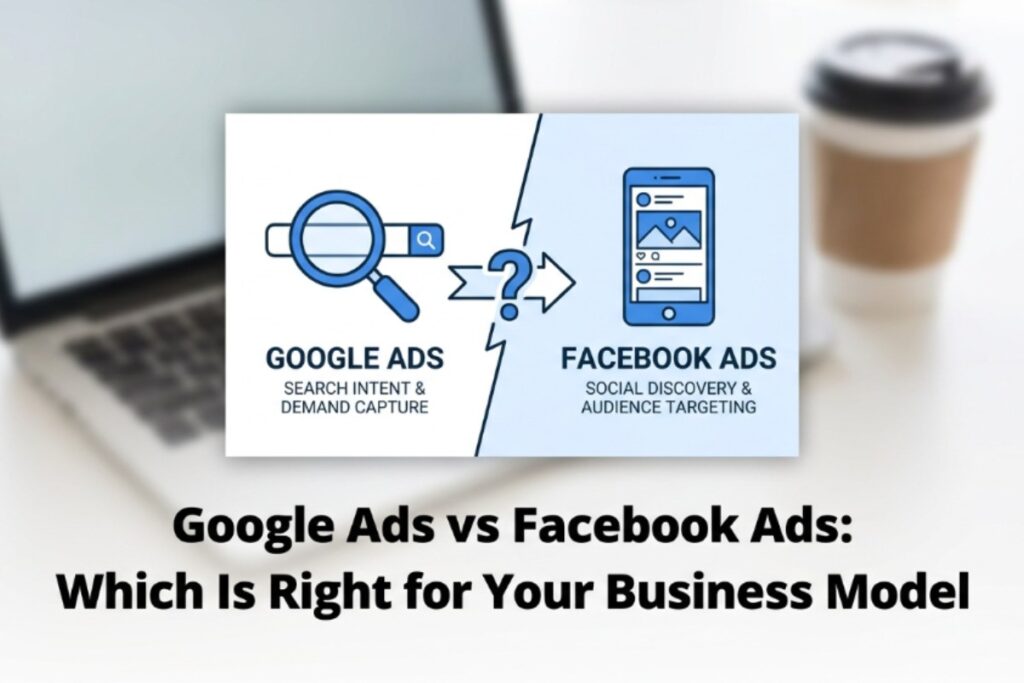
Before comparing features and costs, it’s worth understanding the fundamental philosophical difference between these two platforms because it explains almost everything else.
Google Ads is built on intent. People type something into a search bar because they’re actively looking for it. They might be researching, comparing, or ready to buy right now. Your ad shows up because someone is already looking for what you offer.
Facebook Ads is built on interruption — in the best sense of the word. People aren’t searching for anything when they see your ad. They’re scrolling through photos from a friend’s vacation or watching a video, and your ad appears in that environment based on their interests, behaviours, and demographics. You’re not meeting demand; you’re creating it.
That single distinction shapes nearly every other difference between the two platforms, including cost structure, targeting approach, creative requirements, and the types of businesses that tend to succeed on each.
How Google Ads Works
Google Ads operates primarily on a pay-per-click model tied to search intent. You bid on keywords relevant to your business, and your ad appears when someone searches for those terms. There’s also the Google Display Network and YouTube advertising, but search remains the core of most Google Ads strategies.
Where Google Ads Excels
- High-intent purchases: Someone searching “emergency plumber near me” or “buy running shoes online” is ready to act
- Local service businesses: Plumbers, electricians, lawyers, dentists, and contractors benefit enormously from showing up when someone urgently needs their service
- Established product categories: If people already know they want what you sell and are actively searching for it, Google Ads puts you directly in front of them
- B2B with clear search behavior: Many B2B buyers research solutions by searching specific software categories, comparisons, or industry terms
Where Google Ads Struggles
If your product or service is something people don’t know they need yet, Google Ads has a fundamental limitation: there’s no search volume for something nobody is searching for. A genuinely new product category, an unfamiliar service, or an impulse-buy item that people don’t actively research before purchasing — these are tough fits for a platform built entirely around existing search demand.
Cost is the other major consideration. Competitive industries can have steep costs per click. Legal services, insurance, and certain B2B software categories regularly see click costs of $20, $50, even $100 or more. That makes the math challenging unless your average customer value and conversion rate can support it.
How Facebook Ads Work
Facebook Ads — which includes both Facebook and Instagram placements under Meta’s advertising platform — operates on an interest and behavior-based targeting model. Instead of bidding on what someone is searching for, you define an audience based on demographics, interests, behaviors, past interactions with your business, or similarity to your existing customers.
Where Facebook Ads Excels
- Visual products: Apparel, home goods, beauty products, food and beverage — anything that benefits from compelling imagery or video
- Building brand awareness: Facebook and Instagram are excellent for getting in front of large audiences and introducing your brand, even to people not actively searching for you
- Impulse and discovery purchases: Products people didn’t know they wanted until they saw them — a common pattern in e-commerce and DTC brands
- Retargeting: Re-engaging people who’ve visited your website, abandoned a cart, or interacted with your content is one of Facebook’s strongest use cases
- Lookalike audiences: Once you have existing customers, Facebook can find new people who share similar characteristics – a powerful scaling tool
Where Facebook Ads Struggle
Facebook Ads can be less effective for capturing immediate, high-intent demand. If someone urgently needs a service right now, they’re searching Google, not scrolling Instagram. Facebook is also more vulnerable to ad fatigue — the same audience seeing the same creative repeatedly tends to disengage faster than with search ads, which means the creative needs to be refreshed more frequently.
There’s also been increasing complexity around targeting precision following privacy changes like Apple’s iOS tracking restrictions, which have made some of Meta’s audience targeting and conversion tracking less precise than it once was.
Matching the Platform to Your Business Model
Rather than thinking about which platform is “better” in the abstract, the more useful question is which platform matches how your specific customers behave and buy.
Local Service Businesses
If you’re a contractor, HVAC company, dentist, or law firm, Google Ads – combined with strong local SEO is typically where the majority of your budget should go. When someone’s water heater breaks, they’re not scrolling Facebook hoping to discover a plumber. They’re searching Google immediately, and showing up in that moment is everything.
That said, Facebook Ads can still play a supporting role for these businesses — particularly for retargeting website visitors or building local brand awareness over time.
E-Commerce and DTC Brands
For most product-based e-commerce businesses, Facebook and Instagram tend to deliver strong results, especially in the discovery and consideration stages. Visual, scroll-stopping creative paired with precise audience targeting can introduce your product to people who would never have searched for it by name.
Google Ads still matters here too — particularly Google Shopping campaigns, which capture people actively searching for a specific product. Many successful e-commerce brands run both: Facebook for discovery and top-of-funnel growth, and Google Shopping for capturing people already searching for what they sell.
B2B and Professional Services
This is genuinely mixed territory. If your buyers actively search for solutions – “project management software for construction” or “accounting firm for small business” – Google Ads captures that demand effectively. LinkedIn Ads often outperform Facebook for B2B, specifically due to professional targeting capabilities, but Facebook can still work for brand awareness and retargeting decision-makers who’ve engaged with your content.
Subscription and Membership Businesses
These businesses often benefit most from Facebook’s ability to build awareness and demonstrate value through video and storytelling before someone has even considered a purchase. The consideration cycle tends to be longer, and Facebook’s strength in nurturing audiences over time through retargeting sequences fits that buying pattern well.
High-Ticket, Considered Purchases
For things like real estate, financial services, or expensive B2B software, a combination strategy usually performs best — Facebook to build awareness and capture leads at the top of the funnel and Google Ads to capture people actively comparing options later in their research process.
Comparing the Practical Factors
Cost Structure
Google Ads costs are driven primarily by keyword competitiveness — popular, high-value search terms cost more per click. Facebook Ads costs are influenced by audience size, competition for that audience, and ad relevance — Facebook actually rewards engaging, well-targeted ads with lower costs, which gives strong creatives a real cost advantage on the platform.
Time to Results
Both platforms can generate traffic within days of launching. However, Google Ads conversions from search tend to happen faster because the user already has intent. Facebook Ads conversions often require more touchpoints – a person might see your ad two or three times before converting, particularly for higher-priced items.
Creative Demands
Google Ads search campaigns are primarily text-based, with the strategy centred on keyword selection, ad copy, and landing page relevance. Facebook Ads are fundamentally visual and require an ongoing investment in fresh images, video, and creative testing. If you don’t have the bandwidth or resources for consistent creative production, that’s a meaningful factor to weigh.
Tracking and Attribution
Google Ads benefits from clearer, more direct attribution since the click and the conversion often happen close together. Facebook Ads attribution has become more challenging in recent years due to privacy changes, though Meta’s Conversions API and other server-side tracking solutions have helped close some of that gap.
Why Most Successful Businesses Use Both
The smartest paid advertising strategies for most U.S. businesses don’t treat this as an either-or decision. They use Google Ads and Facebook Ads together, each playing to its strengths within a broader funnel.
Facebook builds awareness and fills the top of the funnel with people who weren’t actively searching but are a good fit. Some of those people will later search Google when they’re ready to make a decision — and showing up for them there, with Google Ads, captures that demand at the moment of highest intent.
Retargeting connects the two beautifully. Someone clicks a Google Ad, visits your site, and doesn’t convert. A well-built Facebook retargeting campaign can bring them back days later with a more compelling offer or social proof. That cross-platform sequence consistently outperforms either channel running in isolation.
Budget allocation between the two should reflect your business model, your customers’ buying behaviour, and — critically — actual performance data rather than assumptions. Testing both at a modest scale before committing a large budget to either is generally the smartest starting point for businesses that haven’t run paid ads before.
This is exactly the kind of strategic decision-making a good paid marketing services company should bring to the table — not just running campaigns on one platform because it’s familiar but also evaluating your specific business model and customer journey to determine the right mix. TrendWaltz approaches every paid advertising engagement this way, building Google Ads and Facebook Ads strategies around how a client’s actual customers research and buy, rather than defaulting to a one-size-fits-all platform choice.
Common Mistakes Businesses Make With Both Platforms
Choosing a Platform Based on Personal Preference, Not Data
Plenty of business owners pick Google Ads or Facebook Ads simply because they personally understand or like that platform better — not because it matches their customers’ actual behavior. That’s a recipe for wasted budget.
Underinvesting in Creative for Facebook
Treating Facebook Ads like a simple boost-the-post exercise, without investing in genuinely compelling visuals or video, is one of the most common reasons campaigns underperform. The platform rewards creative quality, and weak creative gets expensive fast.
Ignoring Landing Page Experience
Both platforms can drive plenty of clicks to a landing page that doesn’t convert. A slow, confusing, or generic landing page undermines even a perfectly targeted, well-written ad. Conversion rate optimization deserves just as much attention as the ad campaign itself.
Setting It and Forgetting It
Paid advertising isn’t a one-time setup. Both platforms require ongoing monitoring, testing, and optimization — adjusting bids, refreshing creative, refining audiences, and pausing what isn’t working. Campaigns left untouched for months almost always become less efficient over time.
Expecting Instant, Permanent Results
Paid ads can generate fast results, but sustainable performance usually comes from ongoing testing and refinement. Expecting a campaign to perform perfectly on day one — or to keep performing at the same level indefinitely without adjustment — sets unrealistic expectations that lead to premature platform-switching.
Final Thoughts
There’s no universal winner in the Google Ads versus Facebook Ads debate, and any answer that claims otherwise probably hasn’t looked closely enough at how different business models actually work.
Google Ads earns its place by capturing people who are already looking for what you offer — that’s an extraordinarily valuable moment to show up. Facebook Ads earns its place by introducing your business to people who would never have thought to search for you, building demand rather than simply meeting it.
The right answer for your business depends on how your customers behave, what you’re selling, and what stage of the buying journey you’re trying to influence. For many businesses, the most effective strategy isn’t choosing one platform over the other — it’s understanding how to use both together, with each one doing the job it’s genuinely best suited for.
Getting that balance right takes testing, data, and experience. But once you find the mix that fits your business model, paid advertising stops feeling like a guessing game and starts becoming one of the most reliable, scalable growth engines available.
Frequently Asked Questions
1. Which platform gives a better return on investment — Google Ads or Facebook Ads?
There’s no single answer because ROI depends heavily on your industry, offer, and audience behaviour. Local service businesses with urgent, high-intent searches — like plumbers or emergency repair services — typically see stronger ROI from Google Ads because they capture people ready to act immediately. E-commerce and visually appealing consumer products often see stronger ROI from Facebook Ads, especially when paired with retargeting, because the platform excels at discovery and building demand for products people weren’t actively searching for. The most reliable way to know which performs better for your specific business is to test both at a modest budget, measure cost per acquisition and lifetime customer value from each, and let the data guide your ongoing allocation.
2. How does TrendWaltz decide which platform to recommend for a client’s advertising budget?
As an experienced ppc services provider, TrendWaltz starts by examining how a client’s actual customers research and make purchasing decisions, rather than defaulting to a single platform. The process typically includes analyzing search volume and intent for relevant keywords, reviewing the client’s average customer value and sales cycle, and evaluating whether the offer is something people actively search for or something that benefits more from visual discovery and awareness-building. From there, TrendWaltz builds a tailored strategy – which might mean Google Ads, Facebook Ads, or a coordinated combination of both — and continuously tracks performance data to refine budget allocation over time based on what’s actually converting, not assumptions.
3. Can a small business with a limited budget run both Google Ads and Facebook Ads at the same time?
Yes, and in many cases, running both at a modest scale is more informative than committing a full budget to just one platform. Even a relatively small budget split between the two — say, testing each with a few hundred dollars over a few weeks — can reveal which platform delivers better-performing leads or sales for your specific business. The key with limited budgets is to start narrow: focus on your highest-intent keywords on Google Ads and your most promising, well-defined audience segment on Facebook, rather than spreading a small budget too thin across broad targeting on either platform.
4. Why did my Facebook Ads stop performing as well as they used to?
This is a common concern, and it usually comes down to one or more of a few factors. Ad fatigue is the most frequent culprit — if the same audience has seen the same creative repeatedly, engagement naturally declines, and costs rise as a result. Privacy changes, particularly Apple’s App Tracking Transparency framework, have also made audience targeting and conversion tracking less precise than they were a few years ago, which can affect performance and reported results. Increased competition for your target audience can drive up costs over time as well. The solution typically involves refreshing creative regularly, testing new audience segments, and ensuring your tracking setup — including server-side tracking through Meta’s Conversions API — is properly configured to capture conversions as accurately as possible.
5. What’s the difference between hiring a general digital marketing agency versus a specialized PPC services provider for paid ads?
A general digital marketing agency typically manages paid advertising as one piece of a broader strategy that might include SEO, social media, and content — which works well when you need integrated, coordinated marketing across multiple channels. A specialized PPC services provider focuses primarily or exclusively on paid advertising, often bringing deeper platform-specific expertise in bid strategy, audience testing, and conversion optimization. Many businesses find the strongest results with a paid marketing services company that has dedicated PPC specialists but still understands how paid advertising fits into the broader marketing picture – combining deep platform expertise with the strategic context of SEO, content, and overall brand positioning, which is the model TrendWaltz is built around.