Ask ten business owners to explain the difference between branding and marketing, and you’ll get ten different answers – several of which will quietly contradict each other. Some treat the two as interchangeable. Others treat marketing as everything and branding as just the logo. A few understand intuitively that they’re different things but struggle to articulate exactly how or why the distinction should change how they spend their time and budget.
This confusion is more than a semantic problem. When branding and marketing get mixed up, businesses make predictable strategic mistakes: they run marketing campaigns without a clear brand foundation, which produces inconsistent messaging that doesn’t build recognition over time. Or they invest heavily in brand identity work without the marketing channels to put it in front of an audience, which produces a beautifully designed business that nobody finds. Or they treat every marketing tactic as equally valid without understanding which ones serve brand-building goals and which ones serve direct-response goals — and end up with a strategy that underperforms on both dimensions.
Getting this distinction right matters practically, not just conceptually. It changes how you prioritize a budget, how you evaluate whether a campaign worked, and how you build a business that grows not just in the short term but over the years.
This guide breaks down exactly what separates branding from marketing, how they interact, and what the distinction means for how you build your digital strategy.
Defining the Terms Clearly
Before exploring the relationship between branding and marketing, it helps to define each one specifically, because the definitions most people carry around are either too narrow or too vague to be useful.
What Branding Actually Is
Branding is the process of defining who you are as a business – your identity, your values, your personality, and the promise you make to customers. It’s the set of perceptions, associations, and feelings that your business creates in the minds of the people who encounter it.
Branding encompasses things like:
- Your visual identity: logo, color palette, typography, and the design language that appears consistently across every touchpoint
- Your brand voice: how your business communicates – the tone, vocabulary, and personality that runs through your copy, emails, social posts, and customer service
- Your positioning: where you sit in the market relative to competitors, and what makes your approach distinct
- Your values and culture: what your business stands for, how it treats customers, and what kind of company it aspires to be
- Your brand promise: the core commitment you make to customers about what they can expect when they choose you
Notice that none of these are primarily about channels or tactics. Branding is about identity — and identity is built slowly, through consistent behavior and presentation over time, not through a single campaign or a logo redesign.
What Marketing Actually Is
Marketing is the set of activities used to communicate your brand, promote your products or services, and persuade potential customers to take action. It operates through specific channels and tactics – SEO, social media, email, paid advertising, and content – and is typically evaluated by measurable outcomes like clicks, leads, conversions, and revenue.
Marketing encompasses:
- Paid advertising: Google Ads, Meta Ads, display advertising, and other paid channels that put your message in front of a defined audience
- Search engine optimization: building organic visibility so that people searching for what you offer can find you
- Social media marketing: building presence, engagement, and community across platforms where your audience spends time
- Content marketing: creating valuable content that attracts, educates, and converts potential customers
- Email marketing: nurturing existing leads and customers through targeted, sequenced communication
Marketing is fundamentally active and channel-specific. It involves campaigns with start and end dates, budgets, performance metrics, and optimization cycles. It produces results that are faster to see and easier to measure than branding — but those results are also more transient, dependent on continued investment to sustain.
The Core Distinction: Strategy vs. Tactics
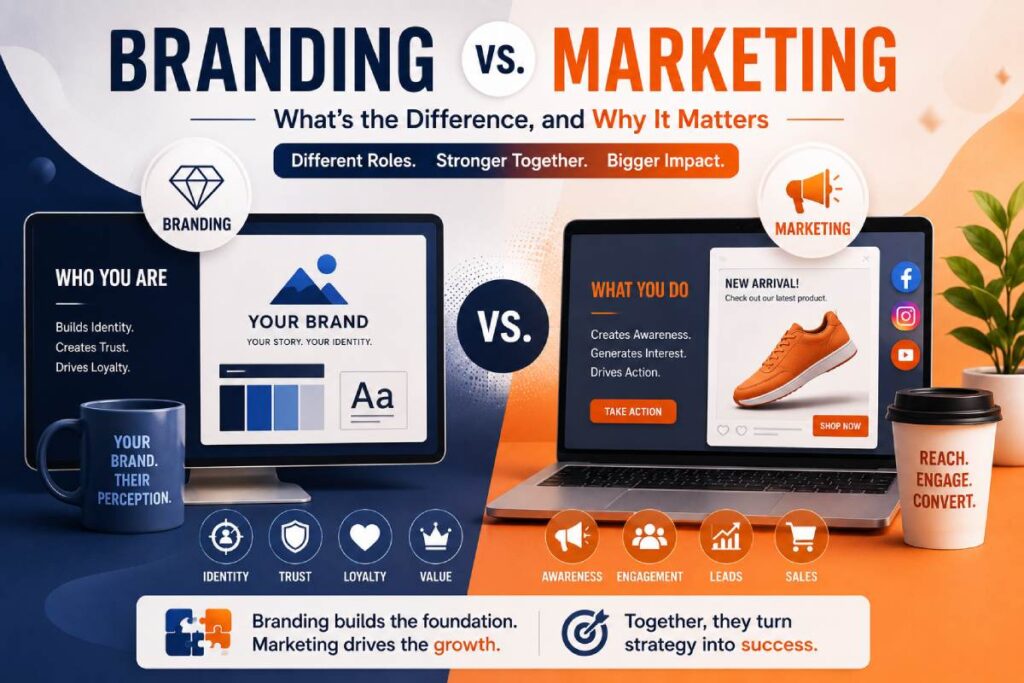
Perhaps the clearest way to understand the difference is this: branding is the strategy that defines what you’re communicating and why, while marketing is the tactical execution of communicating it through specific channels and campaigns.
Branding answers: Who are we? What do we stand for? How do we want to make people feel? What promise are we making?
Marketing answers: How do we reach people? Through which channels? With what messages? At what frequency and cost?
Without a clear brand foundation, marketing becomes a series of disconnected campaigns that may generate short-term results but don’t accumulate into anything durable. Without marketing, even the most compelling brand identity remains invisible — a beautifully articulated position that nobody encounters.
The relationship between the two is sequential and symbiotic. Branding comes first — it defines the foundation that every piece of marketing is built on. Marketing comes second — it carries that brand into the world through channels and campaigns that reach actual customers. When both are working well and working together, the result is greater than either would produce independently.
Why Branding Makes Marketing More Effective
This is the practical argument for investing in brand clarity before scaling marketing spend — and it’s a compelling one.
Consistent Branding Reduces Customer Acquisition Costs Over Time
Marketing to a cold audience is expensive. You’re paying to introduce yourself, establish credibility, and overcome scepticism before any conversion happens. A strong brand — one that’s built recognition and trust through consistent presence over time — lowers the barrier at each of those stages. Customers who’ve encountered your brand multiple times in a consistent, recognisable way are cheaper to convert than strangers who’ve never heard of you.
This is the compounding effect of brand investment: the returns are slow to appear but accelerate meaningfully over time. Businesses with strong brands consistently outperform those without on paid advertising efficiency because brand familiarity reduces the friction that makes cold-traffic conversion so expensive.
Brand Clarity Produces Better Marketing Creative
When a brand has a clear identity — a defined voice, a consistent visual language, a well-articulated positioning — the marketing team (internal or external) has a clear brief to work from. Ad creative, email copy, social content, and landing pages all benefit from that clarity because there’s no ambiguity about what the brand is trying to say or how it’s trying to say it.
Without that clarity, marketing creative tends to drift — inconsistent in tone across channels, visually mismatched between campaigns, and unclear in messaging because nobody has agreed on what the core message actually is.
Strong Branding Builds Loyalty That Marketing Alone Can’t Buy
Customers who feel a genuine connection to a brand — who trust it, identify with it, or have consistently positive associations with it — exhibit fundamentally different behavior than customers acquired purely through promotional marketing. They’re less price-sensitive, more likely to make repeat purchases, and more likely to recommend the brand to others without being asked.
Marketing can acquire a customer. Branding is what makes that customer stay, come back, and tell their network. The lifetime value difference between a brand-loyal customer and a purely transactionally acquired one is one of the most significant and most underappreciated dynamics in building a sustainable business.
Why Marketing Makes Branding Visible
The argument runs the other direction, too. Branding without marketing is an internal exercise — valuable for organizational clarity, but limited in its real-world impact if it doesn’t reach an audience.
Even the most compelling brand positioning needs a distribution mechanism. A business can have exceptional clarity about who it is and what it stands for, but if potential customers can’t find it in search, don’t see it in their social feeds, and aren’t reached by its campaigns, the brand exists only in a document.
Marketing does three critical things for branding:
- It puts the brand in front of audiences that wouldn’t have found it organically — paid advertising, in particular, creates visibility at scale and speed that organic channels can’t match in the short term
- It creates the repeated exposures that brand recognition depends on — a single encounter with a brand rarely builds meaningful familiarity; consistent marketing presence across multiple touchpoints builds the kind of recognition that influences behavior
- It generates the data that informs and refines brand strategy — which messages resonate, which audience segments respond most strongly, and which positioning angles connect versus fall flat. Marketing performance data is one of the richest sources of brand insight available
Where Branding and Marketing Intersect in Digital Channels
In practice, the distinction between branding and marketing isn’t always clean — many digital marketing activities serve both brand-building and direct-response goals simultaneously. Understanding where they intersect helps you evaluate what success looks like for each type of activity.
Social Media: Brand Voice Meets Audience Engagement
Social media is one of the most naturally dual-purpose channels in digital marketing. Organic social content builds brand identity over time — expressing brand voice, reinforcing values, and creating a personality that followers associate with the business. Paid social campaigns drive specific conversions and reach new audiences with targeted messages. Both are social media marketing, but they serve different functions in the branding/marketing spectrum.
A skilled social media services agency understands this distinction and builds social strategies that intentionally serve both goals — developing organic content that builds brand equity over time while running paid campaigns optimized for specific conversion outcomes and ensuring the two feel coherent rather than like they come from different businesses.
SEO and Content: Brand Authority in Search
SEO is a marketing channel — it drives organic traffic and operates through measurable keyword rankings and click-through rates. But it also builds brand authority in ways that have long-term branding implications. A business that consistently appears at the top of search results for topics relevant to its industry creates an association between its brand name and subject-matter authority that influences perception well beyond any individual search.
Content marketing lives similarly at the intersection of both disciplines. A well-executed content strategy drives organic traffic (marketing outcome) while simultaneously building the expert reputation and brand voice that distinguishes a business from competitors (branding outcome). An experienced SEO services agency understands that content investments serve both functions — and builds strategies that capture both types of return rather than optimizing purely for keyword rankings at the expense of brand-building depth.
Paid Advertising: Performance and Perception
Paid advertising is typically the most directly marketing-oriented channel — campaigns have defined objectives, audiences, and measurable return on ad spend. But paid advertising also has a branding dimension that’s easy to undervalue. The creative quality, messaging consistency, and positioning of paid ads contribute to how a brand is perceived by everyone who sees them — not just those who click.
A business whose paid ads feel off-brand — visually inconsistent with the website they lead to, tonally different from the brand’s organic presence, or positioned in a way that doesn’t align with the brand’s core promise — creates a fractured impression that undermines both the immediate campaign performance and the longer-term brand equity being built through other channels. A capable ppc services agency builds campaigns that are both performance-optimized and brand-coherent, treating creative quality and messaging consistency as performance variables rather than aesthetic preferences.
Common Mistakes That Come From Conflating the Two
Understanding the distinction matters most practically in avoiding the strategic errors that come from treating branding and marketing as the same thing.
Rebranding When the Problem Is Actually Marketing
A business that isn’t growing sometimes concludes that the brand needs to change — new logo, new colors, new name. Sometimes that’s the right call. But often the problem isn’t brand identity; it’s that the existing brand isn’t being communicated through the right channels or with sufficient consistency and investment. Rebranding without addressing the underlying marketing distribution problem produces a better-looking business that still doesn’t reach enough people.
Running Marketing Campaigns Without Brand Clarity
Scaling paid advertising, social media, or SEO without a clear brand foundation often produces underwhelming results — not because the channels don’t work, but because the messaging is inconsistent, the visual identity is incoherent across touchpoints, and there’s no clear positioning differentiating the business from competitors. Marketing amplifies what’s there; if what’s there is unclear, marketing amplifies the confusion.
Measuring Brand-Building Activities With Short-Term Marketing Metrics
Brand awareness campaigns, organic social content, and thought-leadership content operate on longer time horizons and produce different types of value than direct-response marketing. Evaluating a brand awareness campaign by its immediate conversion rate is like judging a foundation by whether you can see it from the street. The measurement framework needs to match the goal — brand metrics (recall, recognition, sentiment, share of voice) for brand-building activities, performance metrics (CPA, ROAS, conversion rate) for direct-response marketing.
Treating Brand as a One-Time Project
Brand identity isn’t something that gets defined once and runs on autopilot. It needs to evolve as the business grows, as markets change, and as customer expectations shift. Treating the initial brand identity work as a completed deliverable rather than an ongoing strategic consideration leads to brand drift — a gradual mismatch between how the business presents itself and who it’s actually become.
Building a Strategy That Honors Both
The most effective digital marketing strategies for growing businesses aren’t purely brand-focused or purely performance-focused. They hold both in deliberate tension — investing in brand equity that makes performance marketing more efficient over time, while using performance marketing to generate the revenue and data that informs and sustains brand investment.
In practical terms, this means:
- Defining brand positioning and voice before building campaigns – every channel performs better when it has a clear brief
- Ensuring visual and messaging consistency across all touchpoints – website, paid ads, social, email, and customer communications should all feel like they come from the same entity
- Allocating budget across both brand-building and direct-response activities, rather than optimizing entirely for short-term measurable return at the expense of long-term brand equity
- Measuring success differently for different types of activity – brand metrics for awareness and positioning work, performance metrics for demand generation and conversion campaigns
- Reviewing brand positioning regularly as the business evolves, ensuring that marketing channels are always communicating an identity that’s current and accurate
This is the kind of integrated thinking TrendWaltz brings to clients across every channel. Whether the work involves building organic visibility through SEO and content, running performance campaigns through paid search and social, or developing the social media presence that builds brand equity over time, the underlying approach is always the same: every tactic should serve both the immediate marketing goal and the longer-term brand position being built around it.
Final Thoughts
Branding and marketing aren’t competing priorities — they’re complementary disciplines that each make the other more effective. Branding without marketing remains invisible. Marketing without branding produces noise instead of recognition. Together, executed with consistency and strategic clarity, they create a business that grows not just in revenue but in reputation, loyalty, and the kind of trust that compounds over time.
The distinction matters practically because it changes how you prioritize, how you measure, and how you evaluate what’s actually working. A business that runs great marketing campaigns on a weak brand foundation will hit a ceiling. A business with a strong brand and no marketing distribution will stall. The businesses that win over the long term are the ones that invest in both – treating the brand as the strategy and marketing as the engine that carries it forward.
Getting that balance right is one of the most valuable things a growing business can do for its long-term competitive position. And it’s one of the clearest places where strategic clarity — knowing what you’re trying to build and why — separates the brands that grow from the ones that merely spend.
Frequently Asked Questions
1. Is branding more important than marketing, or vice versa?
Neither is universally more important — they serve different functions, and each depends on the other. Branding without marketing stays invisible; marketing without clear branding produces inconsistent messages that don’t build recognition. Strong businesses invest in both deliberately, treating them as complementary disciplines rather than competing budget lines.
2. How does TrendWaltz integrate brand thinking into its digital marketing work?
TrendWaltz ensures that brand positioning and voice inform every channel it manages — from SEO content strategy to paid ad creative to social presence. Whether working as an SEO services agency building organic authority or managing paid campaigns, the team treats messaging consistency and brand coherence as performance variables, not aesthetic preferences.
3. Can paid advertising help build a brand, or is it only for performance?
Paid advertising builds both. Every impression contributes to brand awareness and perception, not just the clicks that convert. A capable ppc services agency builds campaigns that are performance-optimised while maintaining brand coherence — because creative quality, messaging consistency, and visual alignment all influence both immediate ROAS and long-term brand equity.
4. How does social media marketing serve both branding and marketing goals?
Organic social content builds brand identity, voice, and community over time. Paid social drives specific conversions and new audience reach. A skilled smo services agency manages both simultaneously — ensuring organic content builds long-term brand equity while paid campaigns deliver measurable short-term outcomes, with both feeling visually and tonally coherent.
5. How do I know if my business has a branding problem or a marketing problem?
If existing customers love you but you struggle to grow, it’s likely a marketing distribution problem — your brand isn’t reaching enough people. If you’re generating traffic and leads but conversion and retention are poor, it’s more likely a branding problem — unclear positioning or inconsistent messaging is undermining trust at the decision stage.