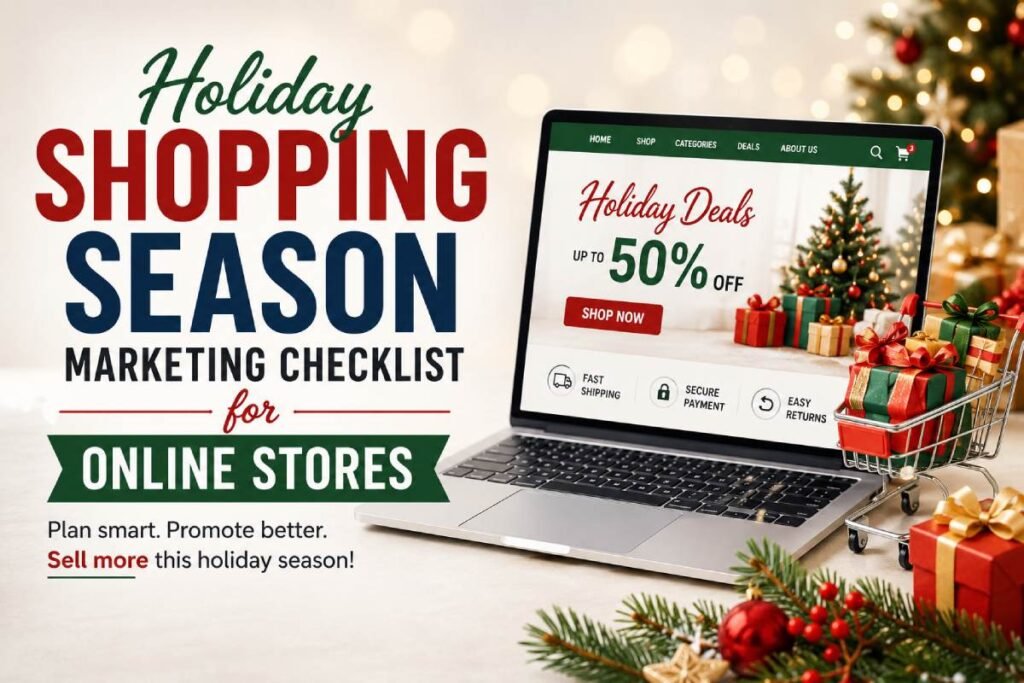
The holiday shopping season is the Super Bowl of e-commerce. For many online stores, the stretch from late October through December represents anywhere from 20% to 40% of their annual revenue — and for some, the number runs even higher. The brands that win this window don’t do it by luck. They show up prepared, with campaigns already running, ads already optimized, and email sequences already loaded before the first shopper types “Black Friday deals” into a search bar.
The brands that struggle? They’re usually the ones who started planning in November. By the time they’re launching campaigns, competitors who started in September have already built warm audiences, tested their creatives, and locked in lower advertising costs before the seasonal surge in competition drives prices up.
This checklist is built for online store owners and marketing teams who want to enter the holiday season ready, not scrambling. It covers everything from the technical preparation your site needs to handle a traffic spike, to the paid advertising strategy that maximizes return during the most competitive ad environment of the year, to the email and social campaigns that convert browsers into buyers during a window when purchase intent is at its annual peak.
Whether you’re a team of one managing every channel yourself or working with outside partners on specific pieces of the strategy, this guide gives you a clear, sequenced picture of what needs to happen and when.
Phase One: Foundation Work (8–10 Weeks Before the Season)
The work that separates a strong holiday season from a frantic one starts well before anyone is thinking about gift lists. This early phase is about infrastructure, audience building, and strategy alignment — the unglamorous preparation that makes everything else perform better.
1. Audit Your Website’s Technical Readiness
Holiday traffic spikes are real, and a site that loads reliably with normal traffic can buckle under the surge of a Black Friday or Cyber Monday push. Before the season starts, run through these critical checks:
- Test page load speed on both desktop and mobile using Google PageSpeed Insights — aim for under three seconds on mobile
- Stress test your hosting environment or ask your hosting provider directly: can the server handle 5x to 10x your typical peak traffic?
- Verify that the checkout flow works without errors across major browsers and devices
- Check that all product pages load correctly, images render at proper sizes, and there are no broken links in your navigation
- Confirm that your SSL certificate is valid and that the padlock shows in the browser — security signals matter more during checkout than at any other point in the shopping journey
A site that crashes or crawls on Black Friday doesn’t just lose that day’s sales. It damages the brand credibility you’ve spent months building, and ad spend sending traffic to a broken experience is pure waste.
2. Segment and Grow Your Email List
Email is consistently one of the highest-ROI channels during the holiday season — but it only performs well if your list is healthy and well-segmented. Eight to ten weeks out is the right time to:
- Clean your list: remove unsubscribers, hard bounces, and long-inactive addresses to protect deliverability
- Segment by purchase history: past buyers, high-value customers, and lapsed customers each warrant different messaging and offer levels
- Run a list growth push: add an exit-intent popup, a holiday preview opt-in, or a waitlist for upcoming deals to capture new subscribers before the season peaks
- Audit your welcome sequence: new subscribers acquired in October should get a flow that warms them toward the brand before the first promotional email arrives
3. Define Your Holiday Offer Strategy
Winging your discount structure and promotional calendar during the season is a recipe for margin erosion and inconsistent messaging. Decide now – while you have time to think clearly – on:
- Which products or collections are you promoting most aggressively, and at what discount levels?
- How are you structuring Black Friday, Cyber Monday, and the December lead-up — as separate events or a connected campaign?
- What’s your free shipping threshold, and does it make sense to adjust it for the season?
- Are you offering gift wrapping, gift cards, or extended returns, and how are those being communicated?
Having these decisions locked before campaign build-out begins means every channel — email, paid ads, social — can be built around a coherent strategy rather than improvised piece by piece as deadlines arrive.
4. Build and Warm Your Paid Advertising Audiences
This is one of the most consequential steps in early holiday preparation — and one of the most commonly skipped. Ad platforms like Meta and Google use historical behavioral data to optimize campaign delivery. An audience that has been building for 60 to 90 days before a campaign launches performs meaningfully better than one built the week before.
Starting eight to ten weeks out, focus on:
- Running brand awareness and traffic campaigns to grow the pool of people who’ve visited your site and can later be retargeted
- Installing or verifying your Meta Pixel and Google Tag Manager setup so conversion events are tracking cleanly before you scale spend
- Building custom audiences from your email list, past purchasers, and website visitors — these become the seed for look-alike targeting during peak season
- Testing ad creative at lower spend to identify which messaging, imagery, and offers generate the strongest engagement before budgets increase
Phase Two: Campaign Build-Out (4–6 Weeks Before the Season)
With the foundation in place, this phase is about building the actual campaigns — paid, email, and social — that will run during the season. Everything here should be ready to launch before peak competition begins.
5. Build Your Holiday Paid Advertising Campaign Structure
The holiday season is the most competitive — and most expensive — paid advertising environment of the year. Ad costs on both Google and Meta climb significantly in October and peak dramatically in late November. Building campaigns now, before costs spike, allows for better testing, smarter optimization, and lower average CPCs across the season.
A well-structured holiday PPC strategy typically includes:
- Prospecting campaigns: reaching new audiences who match your customer profile but haven’t encountered your brand yet — these build the top of the funnel that retargeting works off
- Retargeting campaigns: serving ads to people who’ve visited your site, viewed specific products, or added to cart but not purchased — often the highest-converting campaign type during the season
- Shopping campaigns (for product-based e-commerce): Google Shopping and Meta Catalog ads place product imagery, pricing, and reviews directly in front of high-intent shoppers
- Branded search campaigns: capturing customers who are specifically searching for your brand name, particularly important during promotional periods when competitors may bid on your brand terms
The structure of these campaigns matters as much as the budget behind them. Grouping ad sets by audience temperature (cold, warm, hot), separating campaigns by product category, and setting up distinct budget allocations for Black Friday versus general holiday versus post-Christmas periods all contribute to the kind of control that lets you optimize efficiently during the season rather than making changes blindly.
For stores without dedicated in-house PPC expertise, working with a ppc advertising agency during this build-out phase makes a significant difference – not just in campaign structure, but in bid strategy, audience architecture, and the creative testing process that determines which ads enter the peak season performing well rather than needing to be rebuilt under pressure.
6. Create and Test Ad Creative
Holiday season ad creative needs to work harder than at any other time of year, because the feed is more competitive and consumer attention is pulled in more directions simultaneously. Build your creativity now and spend four to six weeks testing before Black Friday arrives:
- Develop multiple creative concepts — at least three to four distinct angles for each major campaign — so you’re entering peak season with winners already identified, not hoping for the best
- Test static images, carousel formats, and short-form video to understand which format drives the best engagement and conversion for your specific audience
- Build urgency-driven variations for Black Friday and Cyber Monday specifically — countdown language, “limited stock” messaging, and clear discount callouts typically outperform evergreen creative during peak promotional windows
- Ensure all creative is sized correctly for every placement: feed ads, Stories, Reels, and Display all have different optimal dimensions
7. Build Your Holiday Email Campaign Calendar
Email during the holiday season should be a sequenced campaign built around the promotional calendar you defined in Phase One — not a series of one-off blasts. A well-structured holiday email calendar might look like this:
- Early November: “Holiday preview” email for subscribers, early access or loyalty offers for past purchasers
- Week of Thanksgiving: Teaser email building anticipation, Black Friday launch email on the day, cart abandonment follow-ups throughout the weekend
- Cyber Monday: Dedicated campaign with a distinct offer or emphasis from Black Friday
- December lead-up: Gift guides, curated collection highlights, shipping deadline reminders as they approach
- Final push: Last-chance shipping deadline, digital gift card promotion for last-minute shoppers
Subject lines, send times, and offer structures for each of these should be drafted now, reviewed against your promotional strategy, and loaded into your email platform in advance. Doing this work ahead of time means the season runs on a system rather than requiring daily decision-making under pressure.
8. Plan Your Social Media Content Calendar
Organic social media alone won’t carry holiday marketing, but a consistent, well-planned social presence during the season supports brand credibility, extends the reach of paid campaigns, and gives engaged followers a reason to stay connected between promotional emails.
Build a content calendar that includes:
- Product highlights and gift guide content starting in early November
- Behind-the-scenes content that humanizes the brand during a period when many businesses become purely transactional
- User-generated content from happy customers — social proof is particularly influential during peak gift-buying season
- Real-time content around key dates: Black Friday, Cyber Monday, Giving Tuesday, Christmas countdown
- Story and Reel content that promotes your deals in formats that tend to outperform static feed posts for reach
Phase Three: Pre-Season Activation (1–3 Weeks Before Peak)
With campaigns built and tested, this phase is about activating early – capturing early shoppers, warming retargeting pools, and making final optimizations before peak spend begins.
9. Launch Early Access Campaigns
A growing segment of holiday shoppers deliberately shops early to avoid shipping delays, stock issues, and the general stress of last-minute purchasing. An early access campaign — exclusive deals for email subscribers or loyalty members launched two to three weeks before Black Friday — captures this segment while building goodwill with your most engaged customers.
Early access campaigns also generate purchase data that can be used to optimize retargeting and lookalike audiences before Black Friday arrives. A customer who purchased in early November is a strong seed audience for identifying similar buyers during the peak period.
10. Optimize Product Pages for Holiday Conversion
Traffic during the holiday season comes with high intent but also high comparison behavior — shoppers are evaluating multiple options simultaneously and making fast decisions. Product pages need to meet a higher standard during this period:
- Ensure primary product images are high-quality and show the product from multiple angles
- Add social proof prominently: star ratings, review counts, and specific customer quotes near the purchase decision point
- Make shipping timelines and cutoff dates clear and specific — “Order by December 18 for delivery by Christmas” is more persuasive than a generic “fast shipping” claim
- Display gift messaging and gift wrapping options clearly if you offer them
- Simplify the path to checkout: reduce the number of clicks between the product page and the purchase confirmation
11. Activate Abandoned Cart and Browse Abandonment Flows
Abandoned cart emails are among the highest-converting automated sequences in e-commerce during any period of the year — and during the holiday season, when shoppers are comparing multiple stores before committing, they become even more critical.
Before peak season, verify that:
- Your abandoned cart sequence fires reliably and delivers within one to three hours of abandonment — the first email in the sequence is the highest-converting, and timeliness matters significantly
- The sequence includes at least two to three follow-up emails, sent over 24 to 72 hours, with the final one potentially including a small incentive to close the sale
- Browse abandonment emails are set up for high-traffic product categories — reaching shoppers who viewed but didn’t add to cart is an additional recovery opportunity
- All automated sequences are personalized to the specific product abandoned, not just a generic “you left something behind” message
12. Brief Your Customer Service Team
Holiday marketing success creates holiday customer service volume. A surge in orders means a surge in shipping questions, exchange requests, delivery issues, and general enquiries — and a slow or inconsistent customer service response during this period can erase the goodwill a strong promotional campaign builds.
Before the season peaks, ensure your team has clear guidance on:
- Current shipping timelines and carrier delays should be communicated to customers
- Return and exchange policy specifics for holiday purchases
- Escalation procedures for out-of-stock or delayed orders
- Response time expectations across every support channel (email, chat, social DM)
Phase Four: Peak Season Execution (Black Friday Through Cyber Monday)
This is the window most brands think of when they imagine “holiday marketing” — and it’s the one that rewards all the preparation done in the preceding weeks. The goal during peak is not to be building or planning but to be monitoring, optimizing, and responding.
13. Monitor Campaigns Daily and Optimize Aggressively
During peak season, ad performance can shift significantly from day to day — even hour to hour on high-volume days like Black Friday. Daily (or more frequent) campaign monitoring allows you to:
- Increase the budget behind the ad sets and creative performing strongest while reducing spend on underperformers
- Catch and fix any disapproved ads or billing issues before they interrupt campaign delivery
- Monitor cost-per-acquisition in real time and adjust bids or audience targeting if costs move outside acceptable ranges
- Respond to inventory changes quickly — pausing ads for out-of-stock products prevents wasted spend and customer frustration
This kind of active daily management is what separates PPC advertising services that produce strong holiday ROAS from those that launch campaigns and check in weekly. The peak season rewards attentiveness.
14. Push Social Proof in Real Time
During Black Friday and Cyber Monday, real-time social proof — sharing customer photos, posting order-volume milestones, and highlighting product reviews — adds a layer of urgency and credibility that scheduled content can’t replicate. A live Instagram Story showing items selling out creates genuine scarcity signalling. A reposted customer photo generates authenticity that no brand-produced creative fully matches.
Build flexibility into your peak social calendar for this kind of real-time content alongside the scheduled posts already planned.
15. Execute Cyber Monday as a Distinct Campaign
Many brands treat Cyber Monday as an afterthought following Black Friday – extending the same deals with minimal differentiation. Shoppers have come to expect Cyber Monday to have its own distinct offer or emphasis, and brands that deliver on that expectation consistently outperform those that recycle their Black Friday messaging with a new subject line.
If Black Friday led with a sitewide discount, Cyber Monday might lead with free shipping or a specific category. If Black Friday was a single-day push, Cyber Monday might extend across the full week. The goal is enough differentiation to give shoppers who didn’t buy during Black Friday a compelling new reason to act.
Phase Five: Post-Holiday Strategy (December Through January)
Most marketing planning stops at Cyber Monday. But the period from December through early January represents a meaningful and underutilized revenue opportunity for online stores willing to keep the strategy running.
16. Extend the Season Through December With a Clear Narrative
December shopping doesn’t stop after Cyber Monday. It continues — often with increasing urgency as Christmas approaches — through shipping deadlines, and then pivots into gift card redemptions and exchanges after December 25. Plan your December email and paid campaigns around:
- A gift guide phase in early December, organized by recipient or price point
- Shipping deadline reminders as key dates approach – specific, deadline-driven urgency consistently outperforms generic promotional messaging
- A digital gift card push in the final week before Christmas, capturing last-minute shoppers who’ve missed physical shipping windows
17. Capture New Customers for Long-Term Value
Holiday promotions attract a significant number of first-time buyers. This is one of the most valuable outcomes of a strong holiday season — not just the revenue from that initial purchase, but the lifetime value those new customers represent if they’re retained.
After the holiday rush, activate post-purchase flows specifically designed to convert first-time holiday buyers into repeat customers:
- A warm welcome email sequence for new customers acquired during the holiday period
- A follow-up offer or invitation to join a loyalty program, 30 to 45 days after the first purchase
- Retargeting campaigns on paid channels targeting recent purchasers with complementary products
18. Analyze and Document What Worked
The most valuable asset from a well-executed holiday season is the data and learning it generates. Before memories fade and attention moves to Q1 planning, document the following:
- Which campaigns, channels, and creatives produced the strongest ROAS and lowest CPA
- Which email subject lines and send times generated the highest open and conversion rates
- Which products sold the fastest and which saw weaker-than-expected demand
- Which customer segments responded best to which offers and messaging approaches
This documentation becomes the starting point for next year’s holiday planning — compressing the learning curve and giving you a competitive advantage that compounds over multiple seasons.
The Role of Paid Advertising in a Winning Holiday Strategy
Every element of holiday marketing matters — email, social, SEO, product pages, customer service. But paid advertising is uniquely central to holiday season performance for most online stores, for two reasons: it’s the fastest channel to scale during a compressed time window, and it’s the most direct mechanism for capturing high-intent shoppers who are actively searching for what you sell.
The challenge is that the holiday season is also when paid advertising costs are highest and competition for placement is most intense. The brands that get the strongest return from their holiday PPC investment are generally the ones that did the preparation work — building audiences, testing creative, and structuring campaigns — before costs peaked and that had the expertise to manage bids and budgets actively during the season rather than setting campaigns and hoping for the best.
This is where the value of an experienced ppc advertising company becomes most apparent. Managing paid campaigns during Q4 is a different discipline from managing them in Q2 – bid strategies that work in a less competitive environment need adjustment when CPCs double or triple, creative fatigue sets in faster with higher impression volumes, and the margin for error on budget allocation is much smaller when every dollar of ad spend is competing against a field of better-funded seasonal pushers.
TrendWaltz works with online stores through the full holiday season cycle — from audience building and campaign structuring in early fall through active daily management during peak, and into the post-holiday analysis and customer retention phase that sets up Q1. As a full-service ppc advertising agency with experience managing significant holiday season ad budgets, the team brings both the strategic framework and the day-to-day responsiveness that this compressed, high-stakes window demands.
Final Thoughts
The brands that consistently win the holiday season aren’t always the ones with the biggest budgets. They’re the ones who showed up prepared. They built their audiences before the rush. They tested their creativity before the costs climbed. They mapped out their promotional calendar before it became urgent. They treated the holiday season as a strategic initiative with a multi-month build-up, not a six-week sprint that starts with Black Friday.
Use this checklist as a planning framework, not a to-do list to race through in a single week. The phased approach is intentional — some of this work is only valuable if it’s done early enough to compound into results by the time peak season arrives. A warm retargeting audience built in September performs differently from one built in November. Creative tested in October costs less and converts more reliably than a creative launched cold on Black Friday.
Start early. Plan with precision. Execute with discipline. And build the systems — in paid advertising, email, social, and site experience — that make your holiday season not just profitable for this year, but a foundation for doing it even better next year.
Frequently Asked Questions
1. When should an online store start preparing for the holiday shopping season?
Ideally, eight to ten weeks before Black Friday — which means early-to-mid September for most stores. Starting this early allows time for audience building, creative testing, email list growth, and website technical preparation before ad costs spike and competition intensifies in October and November.
2. How does TrendWaltz help online stores with holiday season paid advertising?
As a full-service ppc advertising agency, TrendWaltz manages the complete holiday paid strategy — audience build-out, campaign structuring, creative testing, and daily optimization through peak season. The team brings both the strategic planning and active daily management that high-stakes holiday campaigns require, from early fall through post-holiday analysis.
3. Why do holiday season ad costs spike, and how can I manage my budget effectively?
Ad costs rise in Q4 because more advertisers compete for the same placements simultaneously. Managing this means starting campaigns before costs peak, front-loading creative testing, setting clear ROAS targets to guide daily budget decisions, and working with a ppc advertising company that actively adjusts bids and allocation rather than running campaigns on autopilot.
4. What’s the biggest mistake online stores make with holiday marketing?
Starting too late is the most common and costly mistake. Brands that begin planning in late October are already behind — audiences are unwarmed, creative is unteststed, and email lists haven’t been grown or segmented. The competitive advantage in holiday marketing belongs almost entirely to those who prepare early.
5. Is paid advertising enough on its own, or does holiday success require multiple channels?
Paid advertising alone rarely delivers the full return a coordinated multichannel strategy produces. Email, social media, site experience, and ppc advertising services all compound each other — paid ads retarget email openers, social proof boosts ad conversion rates, and a well-prepared website converts the traffic every other channel delivers.