What Is Organic Reach, Really?
Organic reach refers to the number of people who find and engage with your content without you paying for that exposure. It includes search traffic from Google, followers who see your social media posts in their feed, visitors who stumble across your blog, and people who discover your brand through word-of-mouth or referrals.
It sounds like “free” marketing, and in some ways it is — but that word can be misleading. Organic reach isn’t free. It costs time, consistent effort, and genuine expertise. What it doesn’t cost is direct ad spend.
Where Organic Reach Comes From
- Search Engine Optimization (SEO): Ranking on Google for keywords your audience is actually searching for
- Content Marketing: Blog posts, guides, videos, and podcasts that attract visitors and build authority
- Social Media Presence: Consistent, engaging posts that earn shares, comments, and follows without paid promotion
- Email Marketing: Nurturing your existing subscriber list to drive repeat engagement and conversions
- Online Reviews and Reputation: Word-of-mouth that happens publicly on Google, Yelp, or industry-specific platforms
The Honest Strengths of Organic
Organic reach builds credibility in a way that paid advertising simply can’t replicate. When your website ranks on the first page of Google because it genuinely answers people’s questions well, that earns trust. When customers leave glowing reviews because they had a real experience with your business, that earns trust. Ads can’t manufacture that.
There’s also the compounding effect. A well-written blog post that ranks well today might still be pulling in traffic two or three years from now. A YouTube video that takes off keeps growing without additional investment. Over time, organic content can become one of the most cost-efficient marketing assets a business owns.
Where Organic Falls Short
Patience. That’s the main limitation. Building meaningful organic reach — especially in a competitive market — takes months, sometimes longer. A new business can’t afford to wait six months for SEO to kick in while their cash flow depends on customers showing up now. And organic social reach in particular has declined dramatically on platforms like Facebook and Instagram, where algorithms increasingly favor paid content over unpromoted posts.
Organic also requires consistency. The businesses that win at content marketing and SEO are the ones that show up reliably, over time. If you publish sporadically or stop investing in the channel, your gains erode.
What Is Paid Reach, and How Does It Work?
Paid reach is exactly what it sounds like — exposure you pay for. This includes Google Ads, Meta advertising (Facebook and Instagram), LinkedIn campaigns, YouTube pre-roll ads, display advertising, sponsored content, and more. You set a budget, define your audience, and the platform puts your message in front of them.
Done well, paid advertising is incredibly powerful. Done poorly, it’s an efficient way to burn through your budget without much to show for it.
The Channels That Matter Most
- Google Search Ads (PPC): Showing up at the top of search results for high-intent keywords — people actively looking for what you offer
- Meta Ads (Facebook and Instagram): Targeting by demographics, interests, behaviors, and lookalike audiences to build awareness and drive conversions
- LinkedIn Ads: Reaching professionals and decision-makers, particularly valuable for B2B companies
- YouTube Ads: Video-based advertising that builds brand awareness and reaches users during high-engagement moments
- Retargeting Campaigns: Showing ads to people who’ve already visited your website or engaged with your content — often the highest-converting paid channel
The Real Strengths of Paid
Speed is the defining advantage. A well-configured Google Ads campaign can start driving qualified traffic to your website within 24 to 48 hours of launch. For a new product, a seasonal promotion, or a business that simply can’t wait months for organic momentum to build, that immediacy is invaluable.
Targeting precision is the other major strength. Modern ad platforms give you extraordinary control over who sees your message — down to job title, household income, purchasing behavior, and even the specific videos someone has watched on YouTube. That level of audience targeting is something organic reach can’t replicate.
Paid campaigns are also highly measurable. You can see exactly how much you spent, how many clicks you got, what those clicks cost, and how many converted into leads or sales. That data is actionable in ways that organic metrics sometimes aren’t.
Where Paid Falls Short
Cost is the obvious challenge. The moment you stop paying, the traffic stops. Unlike a blog post that continues ranking in search, a paused ad delivers nothing. In competitive industries, click costs can be steep — some legal or financial keywords on Google cost $30 to $80 per click or more.
There’s also growing ad fatigue. Consumers are increasingly skilled at tuning out ads, particularly on social platforms where they’ve been exposed to advertising formats for years. A campaign that performs well in month one can see diminishing returns as the same audience sees the same creative repeatedly.
And without the right strategy and continuous optimization, paid campaigns can quietly drain budgets while delivering underwhelming results. Many businesses have experienced this firsthand.
The Synergy No One Talks About Enough
Here’s where the conversation gets genuinely interesting — and where most marketing strategies either capture or miss a significant opportunity.
Organic and paid reach don’t just coexist. When they’re intentionally integrated, they amplify each other in ways that produce results neither channel achieves alone. This isn’t a theoretical concept; it plays out in measurable, practical ways.
Paid Ads Fill the Gap While Organic Builds
SEO takes time. Content marketing takes time. Building a social following takes time. Paid advertising gives you a way to generate traffic, leads, and revenue while your organic strategy is still gaining traction. This is especially critical for newer businesses that don’t have an existing audience to lean on.
Think of paid reach as a bridge. You don’t need the bridge forever — once organic traffic is strong enough to sustain your growth goals, you can adjust your ad spend accordingly. But in the early stages, that bridge keeps the business moving.
Organic Content Fuels Better Paid Campaigns
This is one of the most underutilized dynamics in digital marketing. Your organic content — the blog posts, the videos, the guides that perform well without paid promotion — tells you exactly what your audience cares about. It shows you which topics generate the most engagement, which headlines stop people from scrolling, and which formats drive real action.
When you take that data and use it to inform your paid campaigns, you’re not guessing. You’re running ads around content and messages you already know resonate. The result is typically better click-through rates, lower costs per acquisition, and more effective creative.
Retargeting Turns Organic Visitors Into Paying Customers
Someone finds your website through a Google search. They read your blog post, explore your services page, and then leave. That’s an organic touchpoint — and without a next step, that visitor is probably gone for good.
But if you’re running retargeting campaigns, that person now sees a well-crafted ad on Facebook or Instagram reminding them of what you offer. Maybe they see a testimonial from a happy client. Maybe they see a limited-time offer. They’re far more likely to convert on that second or third exposure than they were on the first visit — and that’s paid reach working directly off the foundation your organic strategy built.
This retargeting loop is one of the highest-ROI activities in digital marketing, and it’s only possible when organic and paid are working together.
Paid Traffic Accelerates Content Discovery
You’ve invested time and resources creating a genuinely valuable piece of content — a comprehensive guide, an original research report, an in-depth tutorial. Organic discovery takes time. But a small paid promotion behind that content can seed it to the right audience quickly, generating the initial engagement (shares, backlinks, comments) that helps it gain organic momentum faster.
This is a strategy that smart content teams use intentionally: create something great, then amplify it with paid distribution, let it earn organic traction from there. It’s a force multiplier.
Shared Data Makes Both Channels Smarter
When your paid and organic efforts are managed together — or at least with the same data available to both teams — the insights flow in both directions. PPC keyword data reveals which search terms are converting, which can inform your SEO and content strategy. Organic ranking data shows you which pages are already performing well, which can help you decide where to allocate paid spend for maximum return.
Siloed agencies or fragmented internal teams often miss this. When the same strategic brain is overseeing both channels, that cross-pollination of data happens naturally and continuously.
What This Looks Like in Practice: A Real-World Example
Let’s walk through a scenario that illustrates how this plays out for a typical American small business.
Say you run a home remodeling company in Denver. You’ve been in business for seven years. You get most of your work through referrals, but you want to grow your digital presence and generate a more consistent pipeline of leads.
Month One Through Three: Building the Foundation
You launch a Google Ads campaign targeting high-intent search terms like “kitchen remodel Denver” and “bathroom renovation cost Denver.” The ads start generating calls and form submissions relatively quickly, which keeps revenue coming in while the longer-term work begins.
At the same time, your content team starts publishing well-researched blog posts about home renovation topics — “How Much Does a Kitchen Remodel Cost in Colorado?”, “What to Expect During a Bathroom Renovation”, and similar pieces that your potential customers are actually searching for.
Month Three Through Six: Traction Starts Building
Some of those blog posts start ranking on the second and third pages of Google. Traffic is growing. You set up a retargeting campaign so that anyone who visited your website in the past 30 days sees social ads featuring photos of your completed projects and a few five-star reviews.
Your Google Business Profile is fully optimized. Reviews are being actively collected. You’re starting to appear in the Google Map Pack for local searches, which drives phone calls directly.
Month Six and Beyond: The Flywheel Kicks In
Organic traffic from your blog posts is growing steadily. A few pieces have hit the first page of Google, pulling in consistent, qualified visitors without any ongoing ad spend. Your retargeting ads are converting at a high rate because they’re reaching warm audiences who’ve already found you organically.
You’re now able to scale back your general awareness spending and redirect that budget toward higher-converting retargeting and bottom-of-funnel campaigns, because organic is handling the top-of-funnel discovery.
That’s the flywheel. Organic builds momentum. Paid accelerates and converts. Over time, the cost per customer acquisition goes down even as lead volume increases.
How to Build Your Own Integrated Strategy
You don’t need a massive budget or a huge team to make this work. What you do need is a clear approach and the discipline to execute consistently.
Start With Your Goals and Timeline
If you need leads in the next 30 days, lean heavier on paid. If you’re building for 12-month growth, invest in organic from day one. Most businesses need both — a short-term paid foundation while organic builds, then a gradual rebalancing over time.
Audit What You Already Have
Before spending on ads, understand your organic baseline. How is your website performing in search? Do you have existing content that could be optimized or promoted? Are you capturing and responding to customer reviews? This audit tells you where the organic gaps are and which gaps paid can bridge most efficiently.
Align Your Messaging Across Channels
Nothing undermines a marketing strategy faster than inconsistency. The offer in your Google ad should match what visitors find when they click through. The tone of your social ads should match the voice of your organic content. A unified message builds trust; a fragmented one creates confusion and costs you conversions.
Use Data to Drive Decisions, Not Gut Instinct
Which organic content is generating the most engagement? Double down on that topic. Which paid keywords are converting at the lowest cost? Make sure you have strong organic content supporting those same searches. Let the data tell you where to invest more and where to pull back.
Review and Adjust Regularly
The digital marketing landscape changes constantly. Platform algorithms shift. Ad costs fluctuate. New content formats emerge. A strategy that’s working today may need to be adjusted in six months. Build in regular review cycles — monthly at minimum — to evaluate what’s working and recalibrate.
This is one area where having an experienced partner makes a real difference. TrendWaltz Digital Marketing takes an integrated view of both organic and paid channels from the start — building strategies where SEO, content, PPC, and social advertising are coordinated rather than managed in isolation. For businesses that want their marketing to compound over time rather than just spend, that kind of cohesive approach tends to produce significantly better results.
Common Mistakes to Avoid
Treating Paid as a Short-Term Fix With No Long-Term Plan
Paid advertising should be part of a broader growth strategy, not a substitute for one. Businesses that rely entirely on paid reach without building any organic equity are vulnerable — one algorithm update, one spike in ad costs, or one budget cut can eliminate their entire marketing pipeline overnight.
Neglecting Organic Because Paid Is Working
When paid campaigns are performing well, it’s tempting to deprioritize the slower organic work. Resist that temptation. The businesses that grow most sustainably are the ones that keep investing in organic even when paid is delivering — because when the inevitable rough patches in ad performance hit, organic provides a cushion.
Running Paid Ads to a Weak Website
Paying for clicks that land on a slow, confusing, or unconvincing website is one of the most common — and expensive — mistakes in digital marketing. Before scaling paid spend, make sure your website can actually convert the traffic you’re buying.
Ignoring the Middle of the Funnel
Most marketing attention goes to the top of the funnel (awareness) and the bottom (conversion). The middle — where prospects are comparing options, reading reviews, and looking for reassurance — is often neglected. Content marketing, email nurturing, and retargeting all play a critical role in that middle ground.
Bringing It All Together
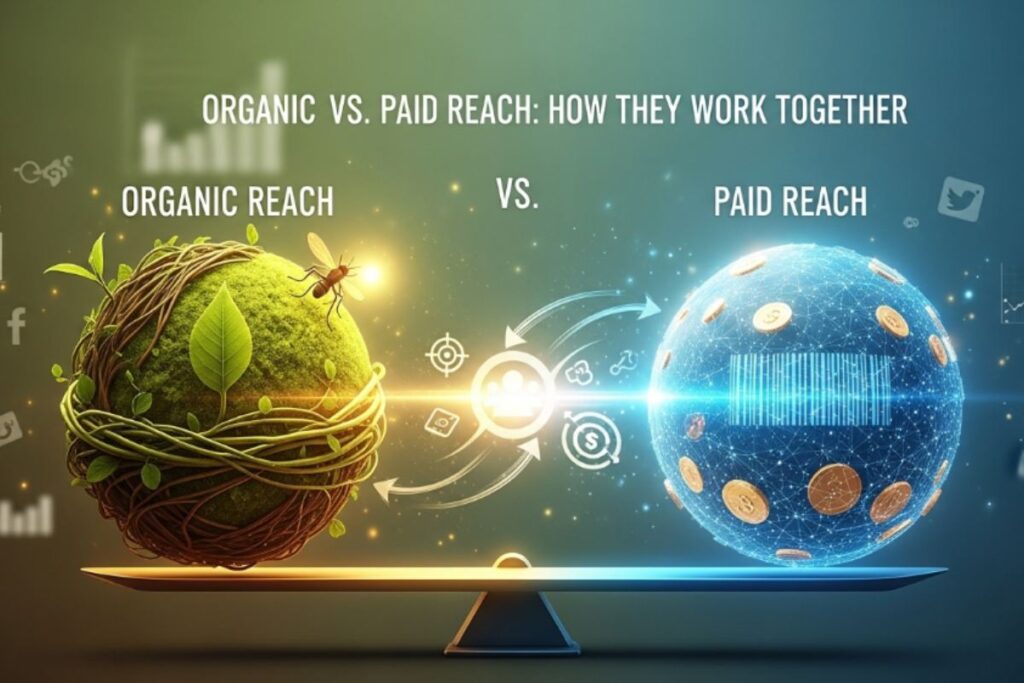
The organic vs. paid debate is a false one. It’s not about choosing sides — it’s about understanding what each channel does well and building a strategy that uses both deliberately.
Organic reach builds the kind of credibility and compounding value that no amount of ad spend can fully replicate. Paid reach delivers the speed, precision targeting, and scalability that organic alone can’t match. Together, they create a marketing engine that’s more resilient, more efficient, and more effective than either is on its own.
The businesses winning at digital marketing right now aren’t the ones with the biggest budgets or the most social media followers. They’re the ones that have figured out how to make organic and paid work in concert — using data, consistency, and smart strategy to build real, sustainable growth.
That’s not a complicated idea. But executing it well, consistently, over time — that’s the work. And it’s absolutely worth doing right.
Frequently Asked Questions
1. Which is better for a small business — organic or paid marketing?
Neither is universally better; the right answer depends on your goals, timeline, and resources. If you need leads quickly — say, within the next 30 to 60 days — paid advertising offers faster results. If you’re building for sustainable long-term growth and have the patience to invest consistently over six months or more, organic strategies like SEO and content marketing tend to deliver compounding returns that paid campaigns can’t replicate. For most small businesses in the U.S., the smartest approach is a combination: use paid to generate early traction and revenue while organic strategies are being built, then gradually reduce reliance on paid as organic momentum grows.
2. How does TrendWaltz Digital Marketing help businesses integrate organic and paid strategies?
TrendWaltz Digital Marketing approaches every client engagement with both channels in mind from day one. Rather than running SEO and PPC as separate programs with separate teams and separate reporting, TrendWaltz builds integrated strategies where the data and insights from each channel actively inform the other. PPC keyword performance shapes content and SEO priorities. Top-performing organic content gets amplified through paid promotion. Retargeting campaigns are built around the audiences organic marketing attracts. This kind of coordinated approach tends to produce stronger results at a better cost per acquisition — and it’s particularly valuable for startups and growing businesses that need every marketing dollar to work as hard as possible.
3. How long does it take for organic marketing to show results?
The honest answer: it varies, and anyone who gives you a precise guarantee is probably overpromising. In general, SEO and content marketing efforts start showing measurable traction within three to six months for most businesses in moderately competitive markets. Highly competitive industries or saturated markets can take longer. Social media organic growth is more variable — some businesses see fast engagement with the right content; others build more gradually. The important thing to understand is that organic marketing is a long-term investment. The returns compound over time, meaning a piece of content or an SEO ranking earned today can keep delivering value for years. That’s fundamentally different from paid advertising, where results stop the moment spending stops.
4. Can I run paid ads without any organic strategy in place?
Technically, yes — and sometimes it makes sense to start with paid while organic foundations are still being built. But running paid ads in isolation, indefinitely, has real risks. First, you become entirely dependent on your ad budget for visibility. If costs rise or the budget gets cut, your pipeline can dry up quickly. Second, paid traffic that lands on a website with thin or unconvincing content tends to convert poorly. People often do a quick Google search or check your social presence after clicking an ad — if your organic footprint is weak, that can undermine the credibility your paid ad just built. A basic organic foundation, even just a well-optimized website and active Google Business Profile, makes your paid investment significantly more effective.
5. What metrics should I track to measure the success of both channels?
For organic, the most important metrics are organic search traffic, keyword rankings (especially for high-intent terms), time-on-page and bounce rate (signals of content quality), and leads or conversions attributed to organic sources. For paid, focus on click-through rate, cost per click, cost per lead or acquisition, conversion rate, and return on ad spend (ROAS). When evaluating the two channels together, look at overall customer acquisition cost across all channels, lead volume and quality by source, and how organic and paid touchpoints appear in the customer journey before conversion. The goal isn’t to crown one channel the winner — it’s to understand how each contributes and optimize the total return on your combined marketing investment.