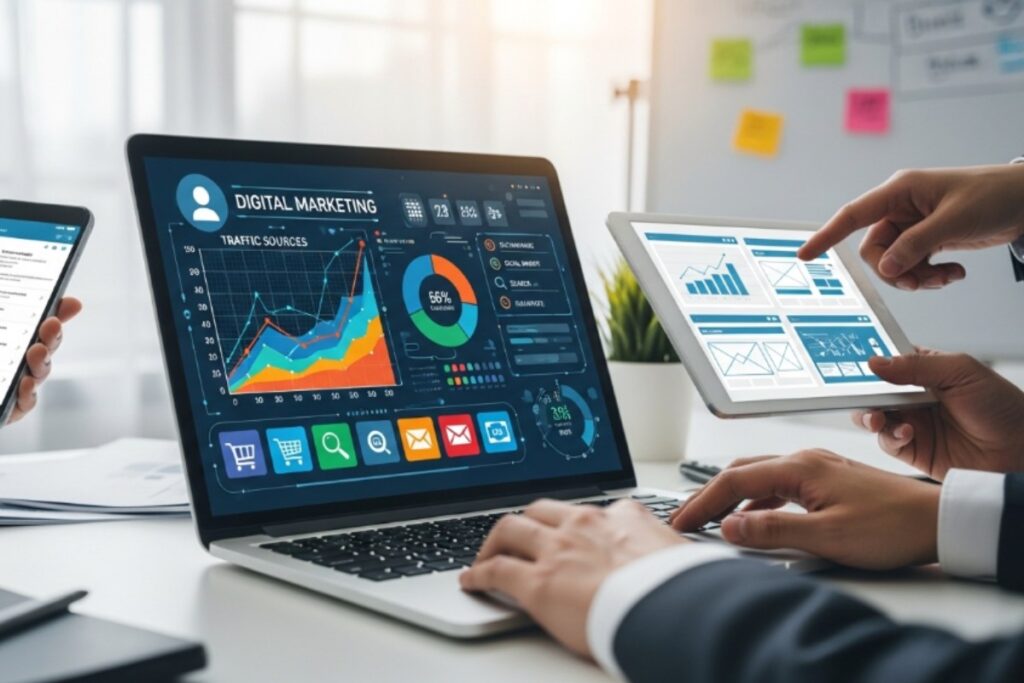
Digital marketing is the use of online channels and digital technologies to promote products, services, and brands. It includes everything from search engines and social media to email campaigns, mobile apps, and paid advertising – all designed to connect businesses with the people most likely to buy from them.
The principles aren’t that different from traditional marketing. You identify your audience, craft a relevant message, and put it where people are paying attention. The difference is that digital marketing gives you far more precision, more reach, and far more data to work with.
Whether you’re a startup trying to build brand awareness or an established company looking to grow revenue, digital marketing is the infrastructure that makes it possible.
How B2B and B2C Digital Marketing Differ
One important nuance: digital marketing doesn’t look identical for every business model.
B2B companies are selling to other businesses, which means longer decision cycles, multiple stakeholders, and a heavier emphasis on trust-building. Content, case studies, LinkedIn, and email sequences matter more here.
B2C companies are selling directly to consumers, where emotional resonance, urgency, and frictionless buying experiences take center stage. Social media, short-form video, and fast-loading product pages are critical.
Both approaches work — but they require different strategies, different content, and different channel mixes.
Why Digital Marketing Matters More Than Ever
The case for digital marketing isn’t just theoretical. It’s backed by where customers actually spend their time and make decisions.
Wider reach, lower cost: A well-written blog post or a targeted ad campaign can reach thousands of relevant people at a fraction of what traditional advertising costs. You can connect with customers across cities, countries, and time zones without a proportionally larger budget.
Measurable results: Unlike a billboard or a magazine spread, digital marketing gives you data. Click-through rates, conversion rates, cost per lead, return on ad spend — these metrics tell you what’s working and what’s not, in real time.
Personalization at scale: Digital channels let you segment audiences and tailor messaging to different groups — first-time visitors versus returning customers, cold audiences versus warm leads. That level of relevance is nearly impossible to achieve with offline channels.
Engagement across the buying journey: A potential customer might discover you through a Google search, follow you on Instagram, read your email newsletter for two weeks, and then click a retargeted ad before finally buying. Digital marketing lets you show up at every one of those moments.
The 12 Core Types of Digital Marketing
There’s no single “right” way to do digital marketing. The best strategies combine multiple channels based on the business, audience, and goals involved. Here’s a clear-eyed look at each major type.
Owned Media
1. Content Marketing
Content marketing is about earning attention rather than paying for it. Blog posts, guides, whitepapers, infographics, podcasts, YouTube videos — the goal is to provide genuine value to your audience, which builds trust and positions your brand as a credible source.
It’s not outwardly promotional. But when done consistently, it generates organic traffic, builds authority, and creates assets that keep working for years.
2. Email Marketing
Despite every prediction about its demise, email remains one of the highest-ROI channels in digital marketing. Welcome sequences, newsletters, post-purchase follow-ups, cart abandonment emails — these touchpoints keep your brand present and drive repeat engagement.
The key is personalization and relevance. A generic blast to your entire list performs far worse than a segmented campaign that speaks to where each subscriber is in their journey.
3. Search Engine Optimization (SEO)
SEO is the process of optimizing your website so it ranks prominently in search engine results for the keywords your target audience is searching. It’s a long-term investment — typically taking 4–9 months to see significant traction — but the payoff compounds over time.
Working with a reliable SEO services company is often the fastest way to get this right. The technical side alone — site architecture, page speed, structured data, crawlability — requires expertise that most in-house teams don’t have bandwidth for. A strong SEO foundation touches on-page content, off-page authority (backlinks), and technical performance simultaneously.
Paid Media
4. Search Engine Marketing (SEM)
SEM refers to paid ads that appear in search engine results. When someone searches for “best accounting software for small businesses,” they see sponsored listings before the organic results. You pay when someone clicks.
Google Ads dominates this space, followed by Microsoft Ads. SEM delivers immediate visibility — unlike SEO, you don’t wait months to appear at the top. The trade-off is that visibility ends the moment your budget does.
5. Pay-Per-Click Advertising (PPC)
PPC is the broader paid advertising model that SEM sits within. It extends beyond search engines to include Meta Ads, YouTube Ads, LinkedIn Ads, Amazon Ads, and more. You bid for placement, and you pay each time someone clicks your ad.
This is where working with a dedicated PPC services company makes a significant difference. Without proper keyword research, bid strategy, audience targeting, and landing page optimization, PPC budgets evaporate quickly without meaningful return. When managed well, it’s one of the most controllable, scalable channels available.
6. Affiliate Marketing
Affiliate marketing lets other people promote your product in exchange for a commission or flat fee. The affiliate has already built trust with their audience — when they recommend your brand, that credibility transfers.
It’s low-risk for the business (you only pay for results) and scalable, since you’re essentially building a distributed salesforce.
Earned Media
7. Social Media Marketing (SMO)
Social media marketing – or SMO (Social Media Optimisation) – builds your brand’s presence across platforms like Instagram, Facebook, LinkedIn, X (formerly Twitter), YouTube, and TikTok. It’s how brands build community, drive organic reach, and stay present in people’s feeds between purchase moments.
Partnering with a competent SMO services company gives you more than just content scheduling. It means building a platform-specific strategy, community management, performance analysis, and creative that actually stops the scroll.
Done right, SMO turns your audience into advocates — people who share your content, leave reviews, and recommend you without any paid incentive.
8. Influencer Marketing
Influencer marketing puts your product in front of an established audience through a trusted voice. The influencer has already done the work of building credibility — your brand benefits by association.
The key is match quality. An influencer with 50,000 engaged followers in your niche will outperform a celebrity with 2 million followers who rarely buy your type of product.
9. Native Advertising
Native ads are paid placements designed to blend in with the surrounding content – they look and feel like organic posts, articles, or videos. Think sponsored articles on news sites or promoted posts in a social feed.
Because they don’t look like traditional ads, native advertising often achieves higher engagement rates. The trade-off is the need for transparency – most platforms require “Sponsored” or “Promoted” labels.
Other Digital Marketing Formats
10. Marketing Automation
Marketing automation handles the repetitive work – sending triggered emails, nurturing leads through sequences, scoring prospects, and measuring campaign performance – so your team can focus on strategy and creativity.
When connected to a CRM, automation creates a seamless handoff between marketing and sales, ensuring no lead falls through the cracks.
11. Mobile Marketing
With mobile devices accounting for the majority of web traffic, mobile marketing has become non-negotiable. SMS campaigns, in-app messaging, push notifications, and mobile-optimized landing pages are all part of this channel.
What makes mobile marketing powerful is immediacy. People have their phones with them constantly, which means the right message at the right moment can drive action faster than almost any other format.
12. Video Marketing
Video has become the dominant content format online. Short-form video on Instagram Reels, TikTok, and YouTube Shorts drives organic reach; long-form YouTube content builds authority; live video creates real-time engagement. Video also outperforms static content in paid advertising.
The barrier to entry has dropped dramatically. A smartphone and a basic lighting setup can produce content that performs better than professionally produced ads from five years ago.
How to Build a Digital Marketing Strategy
Understanding the channels is one thing. Building a cohesive strategy is where most businesses struggle. Here’s the framework that actually works.
Step 1: Define Clear Goals
Every strategy starts with a question: what does success look like? More leads? Higher conversion rates? Lower customer acquisition cost? Better brand awareness in a new market?
Vague goals produce vague results. Set specific, measurable targets — and tie them to metrics like cost per lead, conversion rate, organic traffic growth, or return on ad spend.
Step 2: Know Your Audience
Before you choose a single channel, you need to understand who you’re talking to. Age, location, income — but also motivations, frustrations, and the questions they’re typing into Google. The more specific your audience’s understanding, the sharper your messaging.
Step 3: Set a Realistic Budget
Allocate resources based on your goals and the payoff timeline of each channel. Paid channels like PPC deliver faster results but require ongoing spend. Organic channels like SEO take longer but build lasting assets. Most effective strategies balance both.
Step 4: Choose Your Channels Strategically
Not every business needs every channel. A B2B tech company will likely prioritize LinkedIn, SEO, and email over TikTok. A D2C fashion brand might focus on Instagram, influencer marketing, and Google Shopping. Choose based on where your audience is and where you’re most likely to get a return.
Step 5: Create Content That Serves Each Channel
Content is the fuel. And it needs to be built for each channel’s format and audience behaviour — not repurposed lazily. A LinkedIn article isn’t just a blog post copied and pasted. A TikTok isn’t a TV ad reformatted. Invest in channel-appropriate content.
Step 6: Measure, Analyze, and Adjust
Digital marketing is iterative. Run campaigns, review the data, identify what’s working, cut what isn’t, and improve continuously. The brands that win long-term aren’t the ones with the biggest budgets — they’re the ones who learn fastest.
Where TrendWaltz Fits In
Building and executing a complete digital marketing strategy is a significant undertaking. Most businesses don’t have the internal bandwidth to manage SEO, paid advertising, social media, email, content, and analytics simultaneously — and to do them all well.
TrendWaltz is a full-service digital marketing agency that handles this as an integrated system rather than a set of separate services. As an experienced SEO, SMO, PPC, web design and development and all types of Paid marketing services company operating under one roof, TrendWaltz builds strategies where every channel reinforces the others.
The result isn’t just activity across channels — it’s a connected ecosystem where SEO research informs content topics, paid search data improves landing pages, social engagement shapes email campaigns, and everything is measured against real business outcomes.
Whether you’re starting from scratch or looking to scale an existing strategy, having a partner who thinks about the whole picture — not just individual tactics — is what separates brands that grow from brands that stay stuck.
Digital Marketing Trends Shaping the Near Future
The space moves fast. A few developments worth tracking:
AI-powered personalization: Machine learning is enabling hyper-personalized experiences — content recommendations, dynamic email copy, and ad creative that adapts to individual behavior at scale.
Voice search optimization: With smart speakers and voice assistants becoming household staples, content optimized for natural, conversational queries is gaining ground.
Interactive content: Polls, quizzes, assessments, calculators — these formats drive higher engagement and generate first-party data that’s increasingly valuable as third-party cookies disappear.
Sustainability and ethics: Consumers are paying closer attention to what brands stand for. Authentic messaging around environmental and social responsibility is shifting from “nice to have” to table stakes for younger audiences.
Short-form video dominance: The format continues to expand as the default for discovery across nearly every demographic.
Frequently Asked Questions
Q1: What’s the difference between digital marketing and traditional marketing?
Traditional marketing uses offline channels – TV, radio, print, billboards, and direct mail. Digital marketing uses online and digital channels – search engines, social media, email, websites, apps. The primary advantages of digital are measurability, targeting precision, and a lower barrier to entry. That said, many brands run both in parallel, particularly those targeting audiences that span multiple generations.
Q2: How much should a business budget for digital marketing?
There’s no universal answer, but a commonly cited benchmark is 7–15% of gross revenue for businesses looking to grow, with the percentage varying based on industry, competition, and stage. For new businesses building brand awareness from scratch, the investment is often front-loaded. The more useful starting point is working backward from your customer acquisition cost target to determine what spend makes sense.
Q3: Can small businesses compete with larger brands in digital marketing?
Yes — and this is one of digital marketing’s genuine advantages. A well-targeted SEO strategy can outrank a large competitor in a specific niche. A highly engaging social media presence can build a loyal community regardless of company size. Small businesses often have the advantage of authenticity and speed, which matters more in digital marketing than raw budget.
Q4: How do I know which digital marketing channels are right for my business?
Start with your audience: where do they spend their time online? Then factor in your sales cycle. Short sales cycles with consumer products favour social media and paid ads. Longer B2B cycles favor SEO, content, and email nurturing. Most businesses benefit from testing two or three channels before expanding — trying to do everything at once usually means doing nothing well.
Q5: How long does it take to see results from digital marketing?
Paid channels (PPC, social ads) can show results within days or weeks. SEO typically takes 4–9 months for meaningful organic traction. Email marketing depends on list size and health. Content marketing compounds over time — articles written today may drive significant traffic 12 months from now. The honest answer is that the fastest results come from paid, but the most durable returns come from building organic assets alongside it.
The Bottom Line
Digital marketing isn’t a single thing you switch on and walk away from. It’s a system — a set of channels, strategies, and feedback loops that, when connected and managed consistently, create compounding results over time.
The brands that understand this aren’t just running campaigns. They’re building something. An audience. A body of content. A presence in search results. A community on social. An email list that nobody can take from them.
That’s the real promise of digital marketing — not just traffic today, but assets that keep working tomorrow. And with the right strategy and the right partner, it’s more achievable than most businesses realize.